In the long run firms in both monopolistically competitive markets and perfectly competitive markets earn zero economic profits, but unlike perfectly competitive firms in the long run, monopolistically competitive firms
A) charge a price that is greater than average revenue.
B) charge a price that is equal to marginal cost.
C) do not produce at minimum average total cost.
D) charge a price that is equal to average total cost.
The correct answer and explanation is :
The correct answer is:
C) do not produce at minimum average total cost.
Explanation:
In the long run, both monopolistically competitive firms and perfectly competitive firms earn zero economic profits due to the entry and exit of firms in the market. However, there are key differences in how they operate.
In a perfectly competitive market, firms are price takers, meaning they produce at the point where price (P) = marginal cost (MC) = minimum average total cost (ATC). This ensures that resources are allocated efficiently, and firms operate at their most cost-effective production level.
In contrast, firms in a monopolistically competitive market have some degree of market power because they sell differentiated products rather than identical ones. This differentiation gives them a downward-sloping demand curve, allowing them to set prices above marginal cost. However, due to the ease of entry and exit, firms in monopolistic competition cannot sustain long-run economic profits.
Despite earning zero economic profit in the long run, monopolistically competitive firms do not operate at the minimum of the ATC curve. Instead, they produce at a point where ATC is higher than the minimum, resulting in excess capacity. This occurs because each firm has some pricing power, leading to a price markup over marginal cost, which prevents the firm from achieving the lowest possible production cost.
This inefficiency contrasts with perfect competition, where firms produce at the most efficient scale. However, in monopolistic competition, product differentiation benefits consumers by providing variety, even though it leads to higher costs and prices compared to perfect competition.
Thus, monopolistically competitive firms do not produce at minimum ATC in the long run, making option C the correct answer.
Here is an image illustrating the concept:
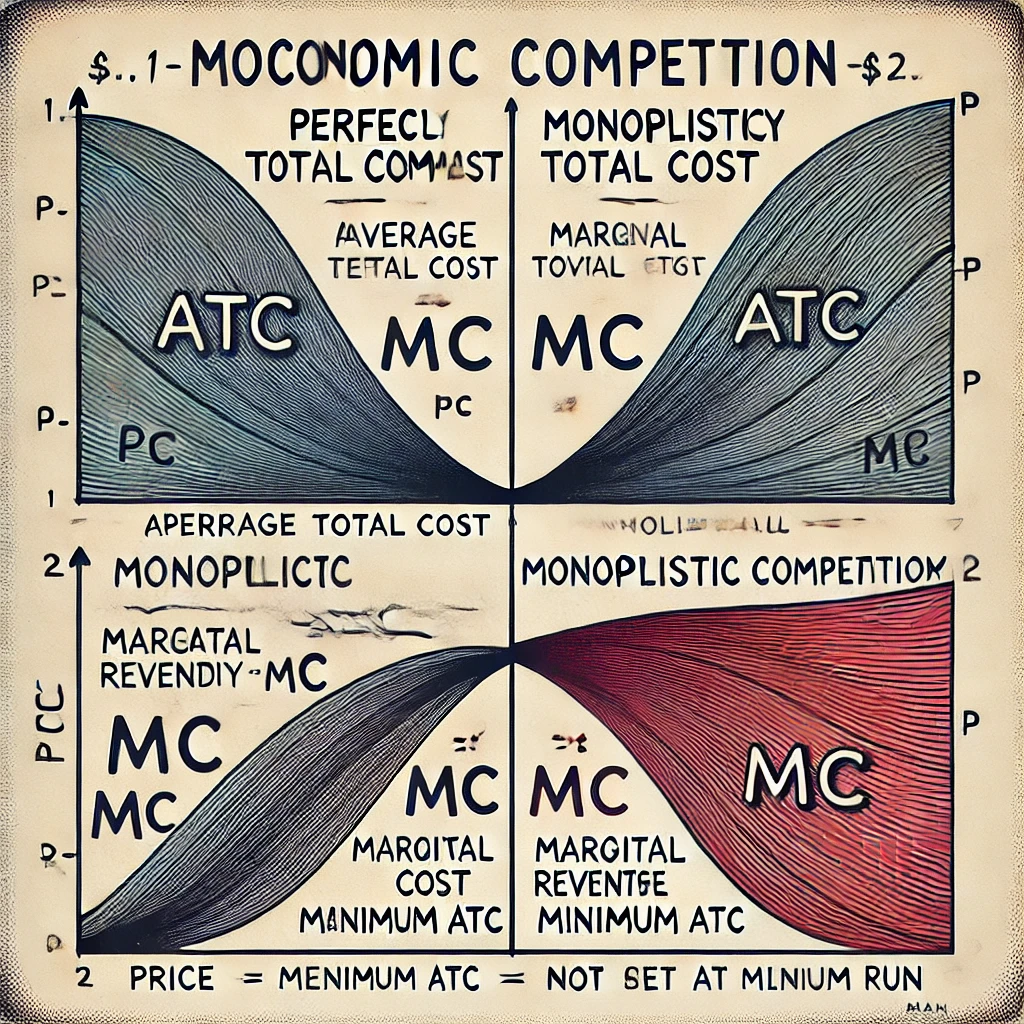
Here is an image illustrating the comparison between perfectly competitive and monopolistically competitive markets. It visually demonstrates that monopolistically competitive firms do not operate at minimum ATC in the long run.