Monopolistically competitive firms have downward-sloping demand curves. In the long run, monopolistically competitive firms earn zero economic profits. These two characteristics imply that in the long run,
A) monopolistically competitive markets achieve productive efficiency.
B) monopolistically competitive markets achieve allocative efficiency.
C) monopolistically competitive firms earn economic profits.
D) monopolistically competitive firms have excess capacity.
The correct answer and explanation is :
The correct answer is:
D) Monopolistically competitive firms have excess capacity.
Explanation:
Monopolistic competition is characterized by many firms selling similar but slightly differentiated products. These firms face downward-sloping demand curves, meaning they have some market power and can set their prices above marginal cost.
In the long run, due to the absence of significant barriers to entry, new firms enter the market when existing firms earn economic profits. This increases competition and reduces demand for each firm’s product until all firms earn zero economic profit—where price equals average total cost (ATC). However, firms still produce at a quantity where price (P) is greater than marginal cost (MC), leading to inefficiencies.
Why firms have excess capacity:
- Productive Efficiency: Achieved when firms produce at the minimum of the ATC curve. However, monopolistically competitive firms do not produce at the minimum ATC because their demand curves are downward sloping. Instead, they produce at a lower quantity than what would be considered efficient, leading to excess capacity.
- Allocative Efficiency: Achieved when P = MC. However, in monopolistic competition, P > MC, meaning consumers pay a higher price than the marginal cost of production. This creates deadweight loss, showing that resources are not allocated optimally.
- Excess Capacity: Since firms do not produce at their lowest cost per unit, they have unused production potential. If demand were higher, they could produce more and lower average costs.
Thus, the presence of excess capacity is a defining feature of monopolistic competition in the long run.
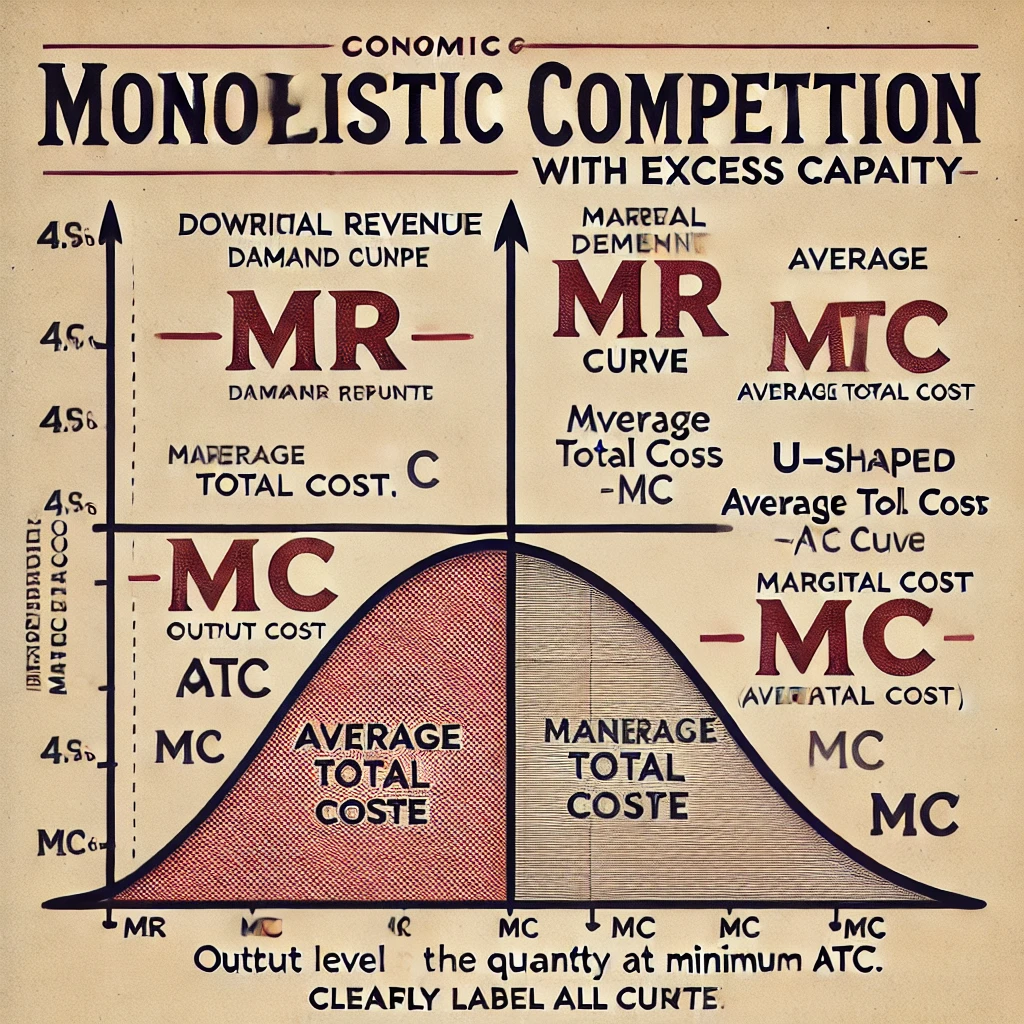
Here is an economic diagram illustrating monopolistic competition with excess capacity. The graph shows the demand curve, marginal revenue (MR) curve, average total cost (ATC) curve, and marginal cost (MC) curve, with the firm’s equilibrium where MR = MC, but the output level is below the minimum ATC, indicating excess capacity.