There are two naturally occurring isotopes of boron. 10B has a mass of 10.0129 amu. 11B has a mass of 11.0093 amu. Determine the abundance of each isotope.
The correct answer and explanation is :
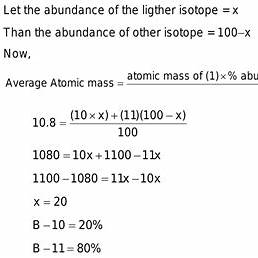
Boron has two naturally occurring isotopes: ^10B, with a mass of 10.0129 atomic mass units (amu), and ^11B, with a mass of 11.0093 amu. The average atomic mass of boron is approximately 10.81 amu. To determine the relative abundances of these isotopes, we can set up a weighted average equation based on their contributions to the average atomic mass.
Let ( x ) represent the fractional abundance of ^10B. Consequently, the fractional abundance of ^11B would be ( 1 – x ). The equation for the average atomic mass becomes:
[ (10.0129\, \text{amu}) \times x + (11.0093\, \text{amu}) \times (1 – x) = 10.81\, \text{amu} ]
Expanding and simplifying:
[ 10.0129x + 11.0093 – 11.0093x = 10.81 ]
[ -0.9964x + 11.0093 = 10.81 ]
Subtracting 11.0093 from both sides:
[ -0.9964x = 10.81 – 11.0093 ]
[ -0.9964x = -0.1993 ]
Dividing both sides by -0.9964:
[ x = \frac{-0.1993}{-0.9964} ]
[ x \approx 0.2001 ]
Therefore, the fractional abundance of ^10B is approximately 0.2001 (or 20.01%), and for ^11B, it is ( 1 – 0.2001 = 0.7999 ) (or 79.99%).
Explanation:
The average atomic mass of an element is a weighted average of the masses of its isotopes, based on their natural abundances. For boron, with isotopes ^10B and ^11B, the average atomic mass (10.81 amu) reflects the combined contributions of these isotopes.
By assigning ( x ) as the fractional abundance of ^10B, we express the fractional abundance of ^11B as ( 1 – x ), since the total abundance must equal 1 (or 100%). The equation ( (10.0129\, \text{amu}) \times x + (11.0093\, \text{amu}) \times (1 – x) = 10.81\, \text{amu} ) represents the weighted average calculation.
Solving this equation involves distributing and combining like terms, isolating ( x ), and performing arithmetic operations to find its value. The resulting ( x ) value indicates the fractional abundance of ^10B, and subtracting this from 1 gives the fractional abundance of ^11B.
These calculated abundances align closely with experimentally determined values, which typically report ^10B at approximately 19.9% and ^11B at approximately 80.1%. Slight discrepancies may arise due to rounding or variations in measurement precision.
Understanding isotopic abundances is crucial in fields like geochemistry and nuclear science, where the specific properties of isotopes influence material behavior and reactions.
For a visual representation of the calculation process, please refer to the following image: