When heated, blue crystals of CuSO4.5H20 release their water of hydration according to the following equation CuSO4.5H2O(s) → CuSO4(s) + 5H20(g)
i. How many phases are present?
ii. Given the number of components, C = 2, determine the number of degrees of freedom
Identify the independent variables that can be varied.
The correct answer and explanation is :
Answer:
i. Phases Present: There are three phases in the system:
- Solid CuSO₄·5H₂O (Hydrated Copper (II) sulfate)
- Solid CuSO₄ (Anhydrous Copper (II) sulfate)
- Gaseous H₂O (Water vapor)
ii. Degrees of Freedom Calculation:
Using the Gibbs Phase Rule:
[
F = C – P + 2
]
Where:
- ( F ) is the degrees of freedom,
- ( C ) is the number of components (( C = 2 ), i.e., CuSO₄ and H₂O),
- ( P ) is the number of phases (( P = 3 )).
Substituting the values:
[
F = 2 – 3 + 2 = 1
]
Thus, the degrees of freedom (F) = 1, meaning that only one independent variable (either temperature or pressure) can be varied while keeping equilibrium.
Explanation:
The reaction involves the dehydration of copper(II) sulfate pentahydrate (CuSO₄·5H₂O) into anhydrous copper(II) sulfate (CuSO₄) and water vapor (H₂O) when heated. This process consists of three distinct phases:
- The solid CuSO₄·5H₂O (hydrated form),
- The solid CuSO₄ (dehydrated form),
- The gaseous H₂O (water vapor).
According to Gibbs’ Phase Rule, the system has one degree of freedom, implying that only one intensive variable, such as temperature or pressure, can be changed independently while maintaining equilibrium among the phases.
Independent Variables:
- Temperature (T): Increasing the temperature favors the decomposition of CuSO₄·5H₂O.
- Pressure (P): Varying the pressure affects the equilibrium concentration of water vapor.
Since F = 1, if we set the temperature, the pressure is determined automatically, or vice versa.
Image Representation:
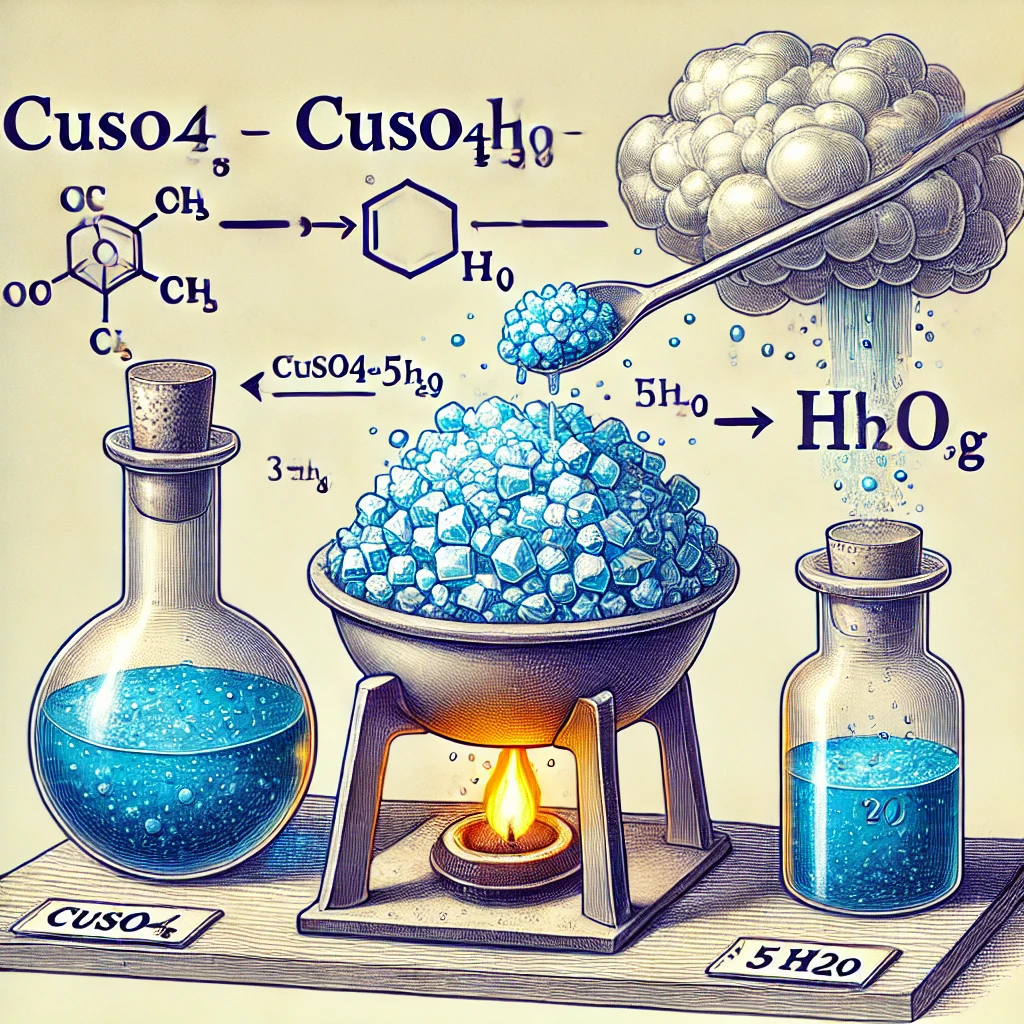
Here is an illustration of the thermal decomposition of Copper(II) sulfate pentahydrate (CuSO₄·5H₂O), showing the different phases involved in the reaction.