Although BH3 and CH2O have similar shapes, one is polar and the other is non-polar. Explain why.
The correct answer and explanation is :
Explanation of Polarity in BH₃ and CH₂O
Both borane (BH₃) and formaldehyde (CH₂O) have a similar trigonal planar molecular geometry, but they differ in their polarity. The key reason lies in their electronegativity differences and symmetry.
1. BH₃ (Borane) – Nonpolar Molecule
- Molecular Geometry: Trigonal planar (120° bond angles).
- Electronegativity Consideration: Boron (B) has an electronegativity of 2.04, while hydrogen (H) has 2.20. Since the electronegativity difference is very small, the B-H bonds are almost nonpolar.
- Symmetry: The three B-H bonds are arranged symmetrically around the central boron atom. As a result, any small dipoles cancel each other out, making the molecule nonpolar.
2. CH₂O (Formaldehyde) – Polar Molecule
- Molecular Geometry: Trigonal planar (due to the presence of a double bond).
- Electronegativity Consideration:
- Carbon (C) has an electronegativity of 2.55.
- Hydrogen (H) has an electronegativity of 2.20.
- Oxygen (O) has a much higher electronegativity of 3.44.
- Dipole Moment: The C=O bond is highly polar due to the large electronegativity difference, creating a strong dipole moment towards oxygen.
- Asymmetry: Unlike BH₃, the dipole moments in CH₂O do not cancel out because the molecule is not completely symmetrical. The oxygen pulls electron density towards itself, making one side of the molecule slightly negative and the other side slightly positive, resulting in a polar molecule.
Conclusion
Even though BH₃ and CH₂O share the same shape, BH₃ is nonpolar due to symmetrical charge distribution, whereas CH₂O is polar due to asymmetry and the highly electronegative oxygen atom.
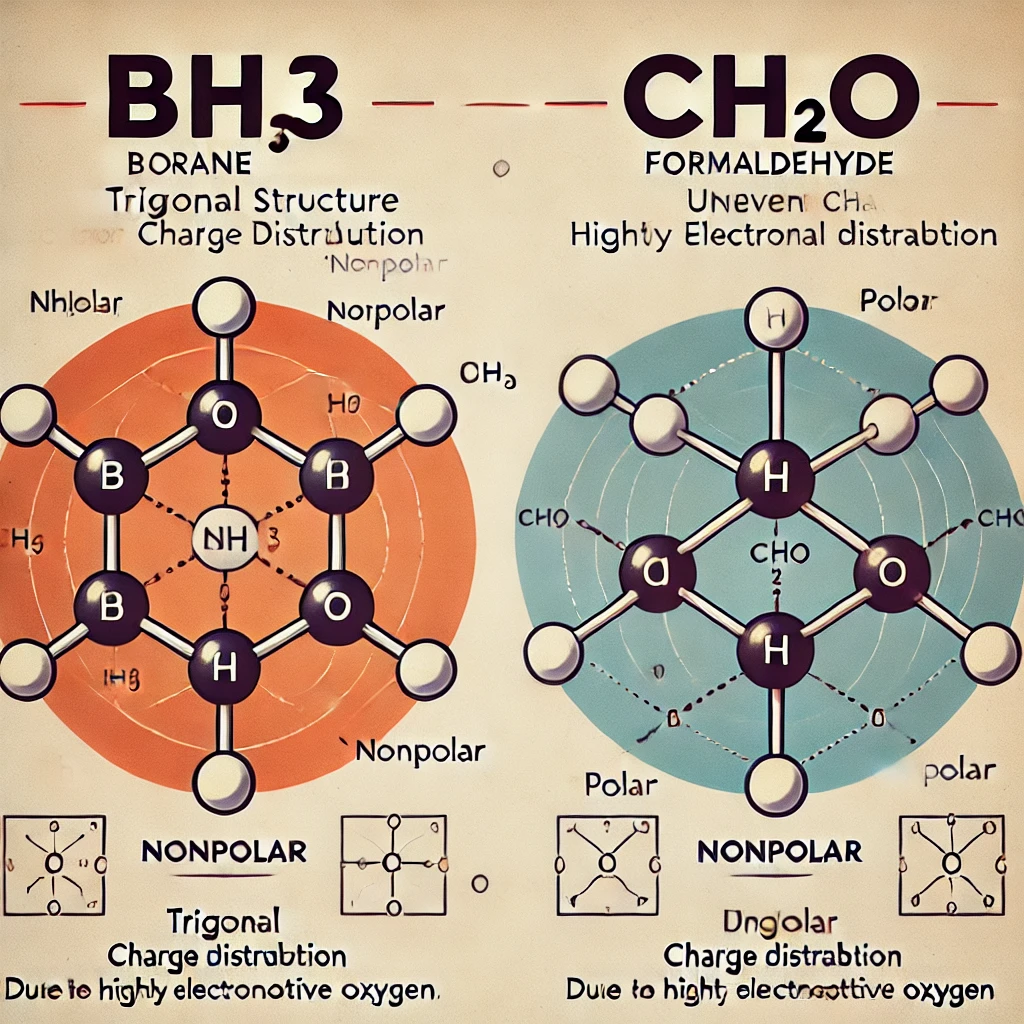
Here is a scientific diagram comparing the molecular structures of BH₃ (borane) and CH₂O (formaldehyde). It illustrates their trigonal planar shapes, the symmetrical charge distribution in BH₃ (nonpolar), and the dipole movement in CH₂O (polar) due to the highly electronegative oxygen.