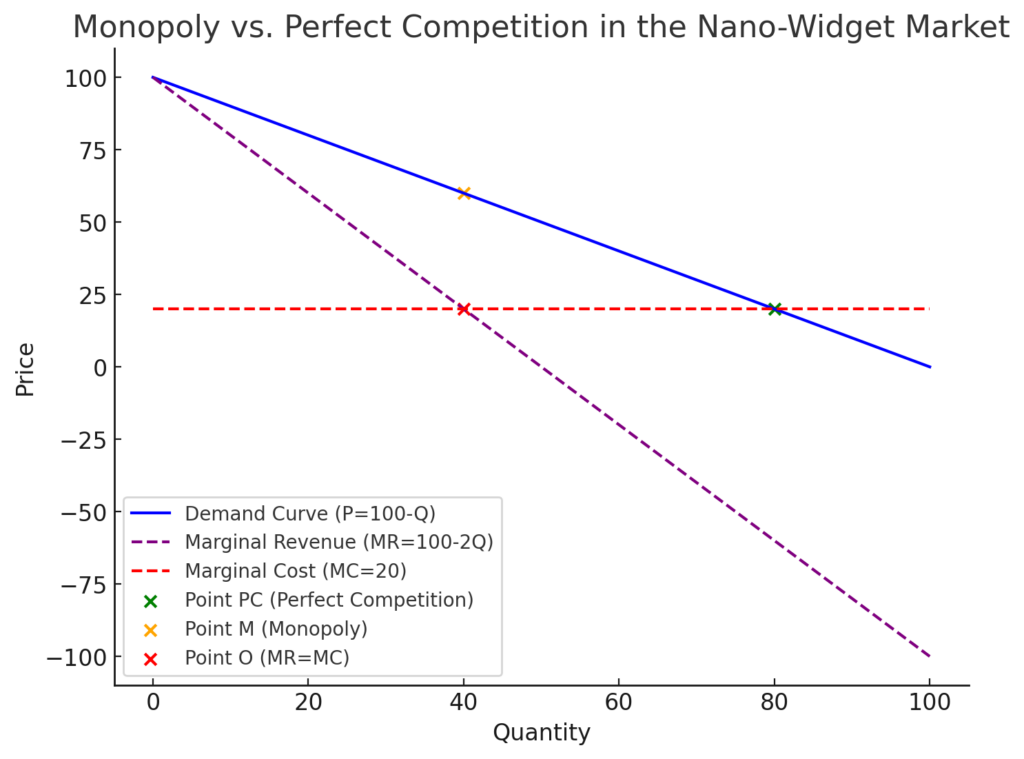
Suppose the conglomerate Enn, Golf \& Devour takes monopoly control of the nano-widget market by acquiring all of the previously perfectly competitive firms in the industry. Use the information about marginal cost (MC), demand, and marginal revenue (MR) in the accompanying graph to answer the questions. Place each of the labeled points as follows: – point PC at the perfectly competitive profit-maximizing price and quantity combination. – point O at the point where marginal revenue is equal to marginal cost. – point M at the monopolist’s profit-maximizing price and quantity combination. When the industry is monopolized, how much surplus is transferred from consumers to the monopolist? What is the monopolist’s producer surplus?
The correct answer and explanation is:
To determine the surplus transfer and monopolist’s producer surplus, let’s analyze the key points based on the provided economic concepts.
Step 1: Identifying Key Points
- Perfect Competition (Point PC):
- In perfect competition, firms produce where Price (P) = Marginal Cost (MC) because firms are price takers.
- This leads to the most efficient allocation of resources, maximizing consumer and producer surplus.
- Monopoly Equilibrium (Point M and Point O):
- A monopolist maximizes profit where Marginal Revenue (MR) = Marginal Cost (MC) (Point O).
- However, since a monopolist sets the highest price consumers are willing to pay at that quantity, the monopoly price is found on the demand curve above the MR = MC quantity (Point M).
- This price is higher than the competitive price, and the quantity is lower than in perfect competition.
Step 2: Surplus Transfer and Producer Surplus
- Consumer Surplus Transfer to the Monopolist:
- The monopolist raises the price above the competitive price.
- As a result, part of the consumer surplus (which consumers used to enjoy in a competitive market) is transferred to the monopolist as additional producer surplus.
- The amount transferred is the rectangular area between the competitive price and monopoly price, covering the monopolist’s quantity.
- Monopolist’s Producer Surplus:
- The producer surplus for a monopoly is the area between the monopolist’s price and the MC curve, up to the monopolist’s quantity.
- Since the monopolist restricts output and raises prices, its producer surplus is larger than in a competitive market but comes at the cost of efficiency.
Step 3: Deadweight Loss
- Some consumer surplus is not transferred but is lost entirely due to the lower quantity produced by the monopolist.
- This is the deadweight loss—the area representing mutually beneficial trades that no longer happen under monopoly.
Now, I’ll generate the graph illustrating these concepts.
The graph above illustrates the transition from a perfectly competitive market to a monopoly in the nano-widget market.
Key Findings:
- Consumer Surplus Transfer to the Monopolist:
- Before the monopoly, consumer surplus was the large triangle above the price of $20 at Q = 80.
- When the market is monopolized, the price rises to $60, and quantity falls to Q = 40.
- The rectangle between $20 and $60 for Q = 40 represents the surplus that was transferred from consumers to the monopolist.
- Monopolist’s Producer Surplus:
- The producer surplus under monopoly is the area between MC = $20 and the monopoly price of $60, up to Q = 40.
- This area is significantly larger than in a perfectly competitive market because the monopolist captures more surplus by setting a higher price.
- Deadweight Loss:
- The loss of surplus due to reduced quantity (from Q = 80 to Q = 40) creates a deadweight loss (DWL).
- This DWL is the triangle between the demand curve and MC for the missing transactions that would have occurred under perfect competition.
Thus, while the monopolist benefits from increased producer surplus, society experiences a net loss due to reduced market efficiency and higher prices.