A fast squirrel is running down a tree at a constant 4.0 m/s. It brushes an acorn with its tail and knocks it loose. The acorn falls and eventually hits the squirrel’s tail.
How far does the acorn fall before hitting the squirrel if it starts from rest?
If the acorn is knocked with an initial velocity of 1.5 m/s downward, how far does it fall before hitting the squirrel?
The correct answer and explanation is :
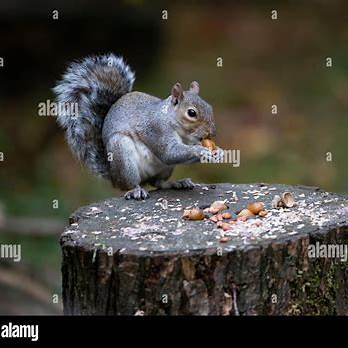
To determine how far the acorn falls before hitting the squirrel’s tail, we can analyze the motion of both the squirrel and the acorn. The squirrel descends the tree at a constant speed of 4.0 m/s, while the acorn is subject to gravitational acceleration (approximately 9.8 m/s² downward).
Case 1: Acorn Starts from Rest
- Time to Impact (t): Since the squirrel moves at a constant speed, the time it takes for the acorn to hit the squirrel is the same as the time it takes for the squirrel to descend the distance the acorn falls. The distance fallen by the acorn (d) is given by the equation for uniformly accelerated motion: [ d = \frac{1}{2} g t^2 ] The squirrel covers the same distance in the same time: [ d = v_{\text{squirrel}} \times t ] Equating the two expressions for distance: [ \frac{1}{2} g t^2 = v_{\text{squirrel}} \times t ] Solving for time (t): [ t = \frac{2 v_{\text{squirrel}}}{g} = \frac{2 \times 4.0\, \text{m/s}}{9.8\, \text{m/s}^2} \approx 0.816\, \text{s} ]
- Distance Fallen (d): Using the time calculated: [ d = v_{\text{squirrel}} \times t = 4.0\, \text{m/s} \times 0.816\, \text{s} \approx 3.27\, \text{m} ] Alternatively, using the free-fall equation: [ d = \frac{1}{2} g t^2 = \frac{1}{2} \times 9.8\, \text{m/s}^2 \times (0.816\, \text{s})^2 \approx 3.27\, \text{m} ]
Case 2: Acorn Knocked with Initial Downward Velocity of 1.5 m/s
- Time to Impact (t): With an initial velocity (u) of 1.5 m/s downward, the distance fallen by the acorn is: [ d = u t + \frac{1}{2} g t^2 ] The squirrel’s distance is still: [ d = v_{\text{squirrel}} \times t ] Equating the two: [ u t + \frac{1}{2} g t^2 = v_{\text{squirrel}} \times t ] Rearranging: [ \frac{1}{2} g t^2 + (u – v_{\text{squirrel}}) t = 0 ] Factoring out t: [ t \left( \frac{1}{2} g t + u – v_{\text{squirrel}} \right) = 0 ] Since t ≠ 0: [ \frac{1}{2} g t + u – v_{\text{squirrel}} = 0 ] Solving for t: [ t = \frac{2 (v_{\text{squirrel}} – u)}{g} = \frac{2 (4.0\, \text{m/s} – 1.5\, \text{m/s})}{9.8\, \text{m/s}^2} \approx 0.510\, \text{s} ]
- Distance Fallen (d): Using the time calculated: [ d = v_{\text{squirrel}} \times t = 4.0\, \text{m/s} \times 0.510\, \text{s} \approx 2.04\, \text{m} ] Alternatively, using the motion equation: [ d = u t + \frac{1}{2} g t^2 = 1.5\, \text{m/s} \times 0.510\, \text{s} + \frac{1}{2} \times 9.8\, \text{m/s}^2 \times (0.510\, \text{s})^2 \approx 2.04\, \text{m} ]
Summary:
- Without Initial Velocity: The acorn falls approximately 3.27 meters before hitting the squirrel’s tail.
- With Initial Downward Velocity of 1.5 m/s: The acorn falls approximately 2.04 meters before impact.
These calculations assume no air resistance and that the squirrel maintains a constant downward velocity.