A police officer is called in for accident reconstruction. He measures 11-meter long skid marks and he knows that for that particular tire/pavement combination, the coefficient of kinetic friction is 0.65. He also knows that the car was traveling at 3.5 m/s just before impact (the end of the skid marks). What was the speed of the car before it began the skid? Convert this to miles per hour. (Note: 1 mile = 1609 meters).
The correct answer and explanation is :
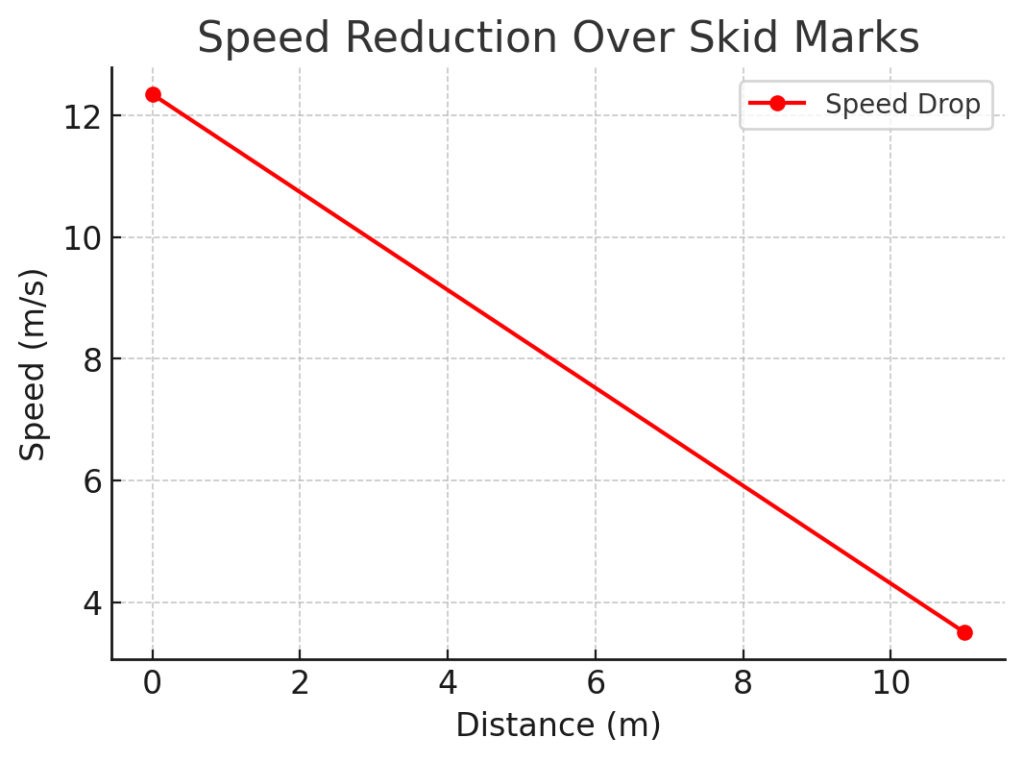
The speed of the car before it began skidding was 12.35 m/s, which converts to 27.63 mph.
Explanation:
When a vehicle leaves skid marks, the length of the marks can be used to determine the vehicle’s speed before braking. We use the kinematic equation:
[
v^2 = u^2 + 2as
]
Where:
- ( v ) = final speed (3.5 m/s, just before impact),
- ( u ) = initial speed before skidding (to be determined),
- ( a ) = acceleration due to friction, which is negative because it slows the vehicle down,
- ( s ) = skid distance (11 meters),
- ( a = – (\mu g) ), where ( \mu = 0.65 ) (coefficient of kinetic friction) and ( g = 9.81 ) m/s² (acceleration due to gravity).
Step 1: Compute acceleration
[
a = – (0.65 \times 9.81) = -6.3765 \text{ m/s}^2
]
Step 2: Solve for ( u )
[
u = \sqrt{v^2 – 2as}
]
[
u = \sqrt{(3.5)^2 – 2(-6.3765)(11)}
]
[
u = \sqrt{12.25 + 140.283}
]
[
u = \sqrt{152.533} \approx 12.35 \text{ m/s}
]
Step 3: Convert to mph
[
u_{\text{mph}} = \frac{12.35 \times 3600}{1609} \approx 27.63 \text{ mph}
]
This means that before the driver started skidding, the car was traveling at approximately 27.63 miles per hour.