A stone is dropped from the roof of a high building. A second stone is dropped 1.50 s later. How far apart are the stones when the second one has reached a speed of 12.0 m/s?
The correct answer and explanation is :
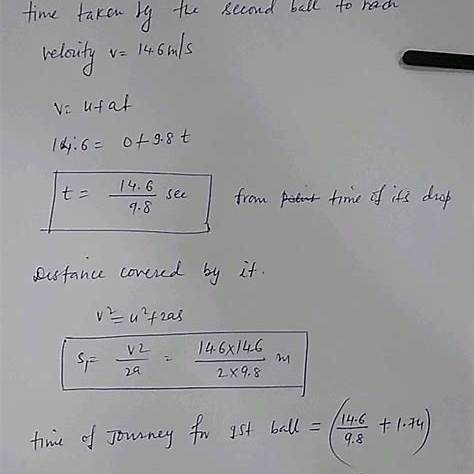
To determine the distance between two stones dropped from a building—one initially and the second 1.50 seconds later—when the second stone reaches a speed of 12.0 m/s, we can follow these steps:
- Calculate the time taken for the second stone to reach 12.0 m/s: Using the equation of motion for velocity under constant acceleration: [ v = u + at ] where:
- ( v ) is the final velocity (12.0 m/s),
- ( u ) is the initial velocity (0 m/s, since it’s dropped),
- ( a ) is the acceleration due to gravity (approximately 9.81 m/s²),
- ( t ) is the time in seconds. Rearranging for ( t ): [ t = \frac{v – u}{a} = \frac{12.0\ \text{m/s} – 0\ \text{m/s}}{9.81\ \text{m/s}^2} \approx 1.22\ \text{seconds} ]
- Determine the distance fallen by the second stone in this time: Using the equation for displacement under constant acceleration: [ s = ut + \frac{1}{2}at^2 ] Substituting the known values: [ s = 0 + \frac{1}{2} \times 9.81\ \text{m/s}^2 \times (1.22\ \text{seconds})^2 \approx 7.3\ \text{meters} ]
- Calculate the total time the first stone has been falling when the second stone reaches 12.0 m/s: The first stone was dropped 1.50 seconds before the second. Therefore, when the second stone has been falling for 1.22 seconds, the first stone has been falling for: [ 1.50\ \text{seconds} + 1.22\ \text{seconds} = 2.72\ \text{seconds} ]
- Determine the distance fallen by the first stone in 2.72 seconds: Using the same displacement formula: [ s = 0 + \frac{1}{2} \times 9.81\ \text{m/s}^2 \times (2.72\ \text{seconds})^2 \approx 36.9\ \text{meters} ]
- Find the distance between the two stones: The separation between the stones is the difference in the distances they have fallen: [ \text{Distance} = 36.9\ \text{meters} – 7.3\ \text{meters} = 29.6\ \text{meters} ]
Explanation:
When an object is dropped from rest, it accelerates downward due to gravity, gaining speed over time. The velocity of a freely falling object increases linearly with time, while the distance it falls increases with the square of time.
In this scenario, the first stone has been accelerating for a longer period, resulting in a greater velocity and distance fallen compared to the second stone. By the time the second stone reaches a speed of 12.0 m/s (after approximately 1.22 seconds), it has fallen about 7.3 meters. During this same interval, the first stone has been falling for a total of 2.72 seconds, covering approximately 36.9 meters. The difference in these distances—29.6 meters—represents the separation between the two stones at that moment.
This problem illustrates the principles of uniformly accelerated motion, where the distance traveled by an object under constant acceleration (like gravity) is proportional to the square of the time it has been falling.