Contribution margin Select one:
a. None of the answers are correct
b. excludes variable selling costs from its calculation.
c. is calculated by subtracting total manufacturing costs per unit from sales revenue per unit.
d. is always the same as gross profit margin.
e. equals sales revenue minus variable costs.
The correct answer and explanation is :
The correct answer is:
e. Equals sales revenue minus variable costs.
Explanation:
Contribution margin is a fundamental concept in cost accounting and managerial decision-making. It represents the amount of revenue available to cover fixed costs and contribute to the company’s profit after accounting for variable costs.
Formula for Contribution Margin:
[
\text{Contribution Margin} = \text{Sales Revenue} – \text{Total Variable Costs}
]
Where:
- Sales Revenue is the total income generated from selling goods or services.
- Variable Costs are costs that change directly with the level of production or sales, such as raw materials, direct labor, and variable selling expenses.
Why Option “E” is Correct:
- Focus on Variable Costs: Contribution margin considers only variable costs, unlike gross profit, which accounts for only manufacturing costs.
- Used in Break-even Analysis: The contribution margin helps determine how much sales revenue contributes to covering fixed costs.
- Profitability Measure: A higher contribution margin indicates that more revenue is available to cover fixed expenses and generate profit.
Why Other Options Are Incorrect:
- Option B: Excludes variable selling costs (Incorrect) → Contribution margin includes all variable costs, whether production-related or selling expenses.
- Option C: Subtracts total manufacturing costs per unit (Incorrect) → Manufacturing costs include both variable and fixed costs, while contribution margin only subtracts variable costs.
- Option D: Always the same as gross profit margin (Incorrect) → Gross profit margin considers only production costs, while contribution margin considers all variable costs.
- Option A: “None of the answers are correct” (Incorrect) → Option E correctly defines contribution margin.
Thus, the best answer is “E. Equals sales revenue minus variable costs.”
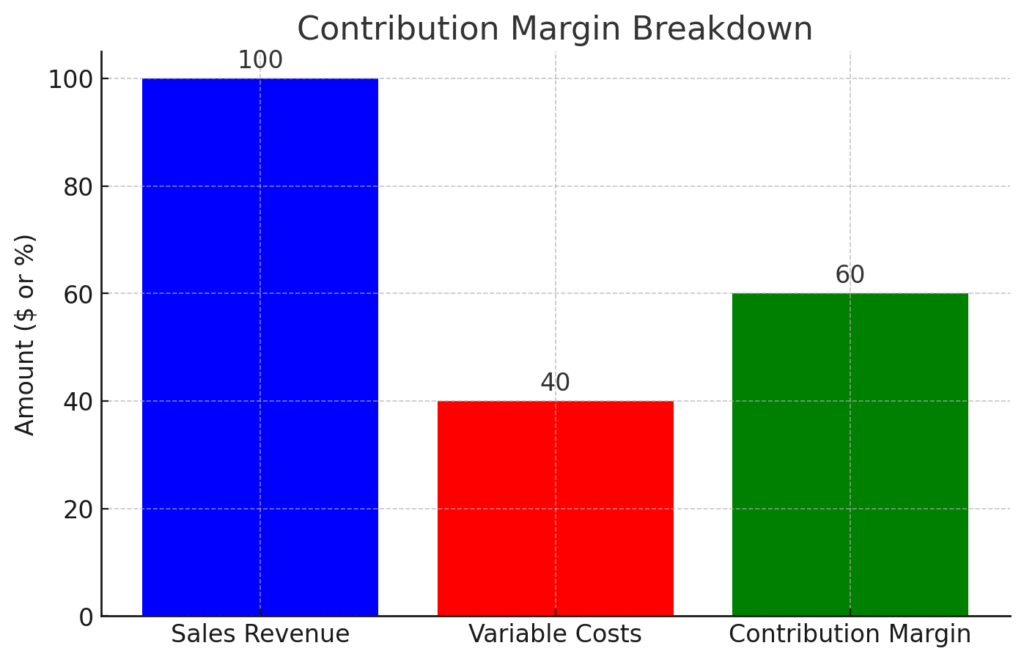
The bar chart above visually represents the contribution margin breakdown. It illustrates how sales revenue is divided between variable costs and the contribution margin, which is the amount left to cover fixed costs and generate profit.