- Head-to-head positioning requires a product to
A. compete with products from competitors of the same size and country of origin.
B. compete with competitors on similar product attributes but in a different market.
C. compete with competitors on similar product attributes in the same market.
D. compete against very similar products from its own company.
E. compete against a single competitor with an identical offering.
- In the athletic shoe market, Reebok and Nike practice __ positioning since both manufacturers vie for the same customers with technologically advanced products.
A. psychological
B. perceptual
C. differentiation
D. head-to-head
E. market
- A positioning approach that involves seeking a less competitive, smaller market niche in which to locate a brand is referred to as __.
A. competitive repositioning
B. head-to-head positioning
C. differentiation positioning
D. downsize positioning
E. product repositioning
- Differentiation positioning requires a product to
A. emphasize unique product attributes to compete directly with competitors.
B. compete directly with competitors on similar product attributes in the same target market.
C. compete with competitors on similar product attributes but in a different market.
D. seek a less-competitive, smaller market niche in which to locate a brand.
E. develop marketing actions to move a product or brand to an ideal position.
- In the sneaker business, Heelys practiced __ positioning when it introduced a line of Heelys sneakers that came with an imbedded, detachable wheel in the shoe’s heel marketed to young teens.
A. head-to-head
B. parallel market
C. lateral
D. repositioning
E. differentiation
- Some Timex wristwatches can be purchased for less than $30 while Rolex wristwatches may carry a price tag of several thousand dollars. In general, consumers view Timex watches as being dependable, relatively accurate, and inexpensive timepieces that can be purchased in drug stores, discount stores, and department stores. The Rolex brand is perceived as an expensive status symbol distributed in fine jewelry stores or specialty shops. By using distinctly different pricing and distribution strategies, the marketers of Rolex watches
A. compete for the same segment through different channels of distribution.
B. develop similar products as Timex but under different names.
C. use a differentiation positioning strategy.
D. compete for the same customers through similar retail outlets.
E. create cognitive dissonance in consumers who purchased Timex wristwatches.
- “For upscale American families who desire a carefree driving experience, Volvo is a premium-priced automobile that offers the utmost in safety and dependability” is a __ statement for Volvo in North America.
A. perception
B. positioning
C. market-product
D. vision
E. differentiation
- A means of displaying or graphing in two dimensions the location of products or brands in the minds of consumers to enable a manager to see how consumers perceive competing products or brands, as well as its own product or brand, is referred to as a
A. perception matrix.
B. growth-share matrix.
C. market-product grid.
D. perceptual map.
E. product differentiation chart.
- A perceptual map refers to
A. a framework used to compare one firm’s product offerings with another firm’s offerings in relationship to their relative market share.
B. a framework used to demonstrate the growth or decline of specific market segments within an industry.
C. a means of displaying or graphing in two dimensions the location of products or brands in the minds of consumers to enable a manager to see how consumers perceive competing products or brands, as well as its own product or brand.
D. a framework to relate the market segments of potential buyers to the products offered or potential marketing actions by an organization.
E. the place a product occupies in a single consumer’s mind on unimportant attributes relative to competitive products.
- A graph displaying consumers’ perceptions of product attributes in two dimensions is referred to as a
A. perceptual map.
B. perception matrix.
C. growth-share matrix.
D. market-product grid.
E. product differentiation chart.
The correct answer and explanation is:
Correct Answers:
- C. Compete with competitors on similar product attributes in the same market.
- D. Head-to-head
- C. Differentiation positioning
- D. Seek a less-competitive, smaller market niche in which to locate a brand.
- E. Differentiation
- C. Use a differentiation positioning strategy.
- B. Positioning
- D. Perceptual map.
- C. A means of displaying or graphing in two dimensions the location of products or brands in the minds of consumers to enable a manager to see how consumers perceive competing products or brands, as well as its own product or brand.
- A. Perceptual map.
Explanation:
In marketing, positioning is a key strategy that determines how a product is perceived in relation to competitors. Head-to-head positioning (Q191, Q192) occurs when companies compete on similar attributes within the same market, as seen with Nike and Reebok. Alternatively, differentiation positioning (Q193, Q195) involves finding a niche by offering unique attributes, such as Heelys adding wheels to sneakers.
When brands like Rolex and Timex position themselves with different pricing and distribution (Q196), they are engaging in differentiation, making each appealing to distinct consumer segments. Positioning statements (Q197) help communicate a brand’s unique value, as seen with Volvo emphasizing safety and dependability.
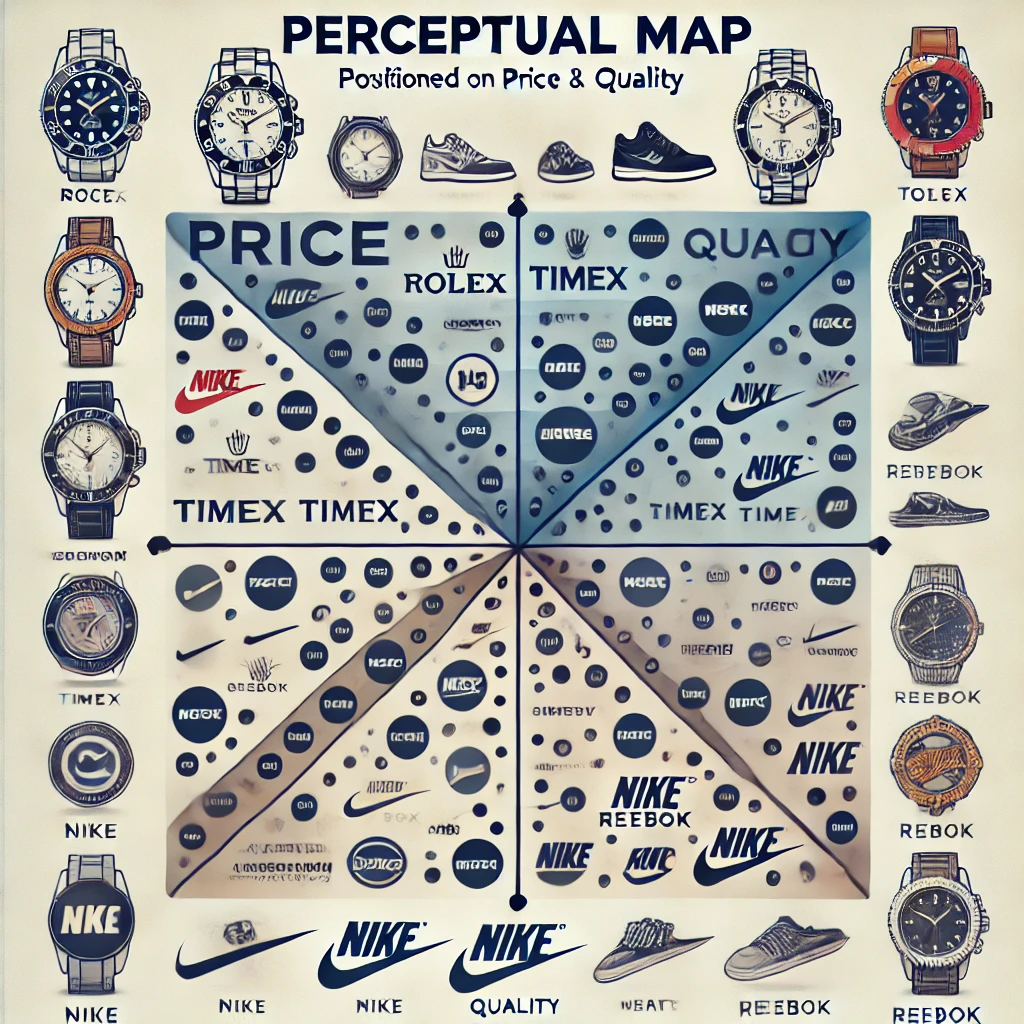
A perceptual map (Q198, Q199, Q200) is a visual tool used in marketing to show how consumers perceive brands based on attributes like price and quality. This helps companies understand their competitive landscape and strategize effectively.
By understanding and applying these concepts, businesses can effectively position their products to appeal to their target audience and stand out in competitive markets.
Now, generating an image of a perceptual map showcasing different brands based on quality and price.
Here is the perceptual map visually displaying various brands positioned based on price and quality. Let me know if you need any modifications or further explanations!