Physics Neglecting air resistance, an object in free fall accelerates at 32 feet per second squared. So the velocity of the object t seconds after being dropped is 32t feet per second. Suppose a ball is dropped from the top of the Sears Tower.
a. Use integration to find how far the ball would fall in the first six seconds.
b. Refer to the graph at the right. Would the ball hit the ground within ten seconds of being dropped? Explain your reasoning.
The correct answer and explanation is :
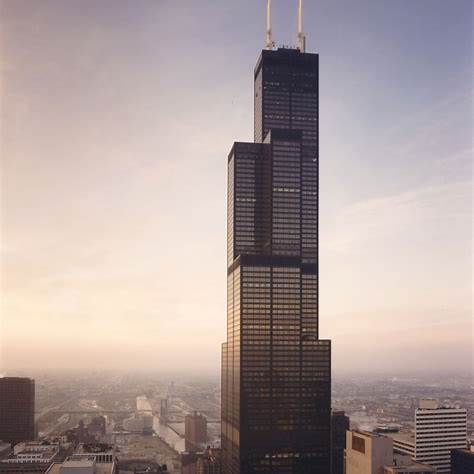
Neglecting air resistance, an object in free fall near Earth’s surface experiences a constant acceleration due to gravity, approximately 32 feet per second squared (ft/s²). The velocity ( v(t) ) of the object after ( t ) seconds is given by ( v(t) = 32t ) ft/s.
a. Distance Fallen in the First Six Seconds
To determine the distance ( s(t) ) the ball falls in the first six seconds, we integrate the velocity function:
[ s(t) = \int v(t) \, dt = \int 32t \, dt = 16t^2 + C ]
Assuming the ball is dropped from rest (initial velocity is zero) and from the top of the tower (initial position is zero), the constant ( C ) is zero. Therefore, the distance function simplifies to:
[ s(t) = 16t^2 ]
After six seconds, the distance fallen is:
[ s(6) = 16 \times 6^2 = 16 \times 36 = 576 \, \text{feet} ]
b. Will the Ball Hit the Ground Within Ten Seconds?
The Willis Tower (formerly Sears Tower) in Chicago stands at a height of 1,450 feet (442 meters) citeturn0search24. To determine if the ball hits the ground within ten seconds, we calculate the time ( t ) it takes to fall 1,450 feet using the distance function:
[ s(t) = 16t^2 = 1,450 ]
Solving for ( t ):
[ t^2 = \frac{1,450}{16} \approx 90.625 ]
[ t \approx \sqrt{90.625} \approx 9.52 \, \text{seconds} ]
Since 9.52 seconds is less than 10 seconds, the ball would indeed hit the ground within ten seconds of being dropped.
Explanation
In free fall, an object’s acceleration due to gravity is constant, leading to a linear increase in velocity over time. The distance fallen is proportional to the square of the time elapsed, as shown by the equation ( s(t) = 16t^2 ). This quadratic relationship indicates that the distance increases rapidly as time progresses.
By integrating the velocity function, we derive the distance function, which allows us to calculate the exact distance fallen at any given time. In this scenario, after six seconds, the ball falls 576 feet. Given the total height of the Willis Tower is 1,450 feet, we can set up the equation ( 16t^2 = 1,450 ) to solve for the time it takes to reach the ground. Solving this equation yields approximately 9.52 seconds, confirming that the ball will impact the ground within the ten-second timeframe.
It’s important to note that these calculations assume the absence of air resistance and other potential factors that could alter the ball’s trajectory and time of descent. In real-world scenarios, air resistance would play a significant role, reducing the acceleration and increasing the time taken to reach the ground. However, for the purposes of this theoretical exercise, neglecting air resistance provides a simplified model to understand the fundamental principles of free fall under constant acceleration.