The coefficient of kinetic friction between a particular car’s tires and the ground is 0.60. The coefficient of static friction is 0.75.
Given the above information and the assumption that friction is the limiting factor, not the car’s engine, determine the maximum acceleration of the car. Use this to determine the time to accelerate from zero to 60 miles per hour. (1 mile = 1.61 km)
Determine the minimum stopping distance of the car if it is moving at a speed of 15 m/s. Repeat assuming the driver locks the brakes and skids to a stop.
The correct answer and explanation is :
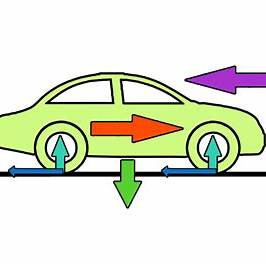
To determine the maximum acceleration of a car, the time required to accelerate from 0 to 60 miles per hour, and the minimum stopping distances under different braking conditions, we can analyze the forces involved, primarily focusing on friction.
1. Maximum Acceleration:
The maximum acceleration (( a_{\text{max}} )) a car can achieve without slipping is governed by the static friction between the tires and the road. The static frictional force (( F_{\text{friction}} )) is given by:
[ F_{\text{friction}} = \mu_s \times N ]
where ( \mu_s ) is the coefficient of static friction and ( N ) is the normal force. For a car on a flat surface, the normal force equals the weight of the car (( N = m \times g )), where ( m ) is the mass and ( g ) is the acceleration due to gravity. The maximum frictional force thus becomes:
[ F_{\text{friction}} = \mu_s \times m \times g ]
According to Newton’s second law, ( F = m \times a ). Setting the maximum frictional force equal to the maximum possible accelerating force:
[ m \times a_{\text{max}} = \mu_s \times m \times g ]
Simplifying, we find:
[ a_{\text{max}} = \mu_s \times g ]
Given ( \mu_s = 0.75 ) and ( g = 9.81 \, \text{m/s}^2 ):
[ a_{\text{max}} = 0.75 \times 9.81 \approx 7.36 \, \text{m/s}^2 ]
2. Time to Accelerate from 0 to 60 mph:
First, convert 60 miles per hour to meters per second:
[ 60 \, \text{mph} = 60 \times 1.61 \, \text{km/h} = 96.6 \, \text{km/h} ]
[ 96.6 \, \text{km/h} = \frac{96.6 \times 1000}{3600} \approx 26.83 \, \text{m/s} ]
Using the kinematic equation ( v = a \times t ), where ( v ) is the final velocity, ( a ) is acceleration, and ( t ) is time:
[ t = \frac{v}{a} = \frac{26.83}{7.36} \approx 3.64 \, \text{seconds} ]
3. Minimum Stopping Distance from 15 m/s:
The minimum stopping distance (( d )) when the car is moving at an initial velocity (( v_0 )) and decelerates at ( a_{\text{max}} ) is given by:
[ v^2 = v_0^2 – 2 \times a \times d ]
Setting the final velocity (( v )) to 0:
[ 0 = (15 \, \text{m/s})^2 – 2 \times a_{\text{max}} \times d ]
Solving for ( d ):
[ d = \frac{(15)^2}{2 \times 7.36} \approx 15.28 \, \text{meters} ]
4. Stopping Distance with Locked Brakes (Skidding):
When brakes are locked, kinetic friction (( \mu_k )) dictates the deceleration:
[ a_{\text{skid}} = \mu_k \times g = 0.60 \times 9.81 \approx 5.89 \, \text{m/s}^2 ]
Using the same kinematic equation:
[ d_{\text{skid}} = \frac{(15)^2}{2 \times 5.89} \approx 19.10 \, \text{meters} ]
Explanation:
The car’s maximum acceleration is limited by the static friction between the tires and the road. Static friction prevents the tires from slipping and allows the car to accelerate effectively. Once the applied force exceeds this limit, the tires begin to slip, transitioning to kinetic friction, which offers less resistance.
The time to accelerate from 0 to 60 mph depends on this maximum acceleration. A higher static friction coefficient allows for greater acceleration, reducing the time needed to reach the desired speed.
For stopping distances, the car decelerates at a rate determined by the available friction. With optimal braking (without locking the brakes), static friction provides maximum deceleration, resulting in a shorter stopping distance. However, if the brakes are locked, the tires skid, and kinetic friction—which is lower than static friction—takes over, leading to a longer stopping distance.
Understanding the distinction between static and kinetic friction is crucial for vehicle safety. Maintaining tire traction (static friction) ensures better control during acceleration and braking. Once traction is lost (kinetic friction), control diminishes, and stopping distances increase, highlighting the importance of anti-lock braking systems (ABS) that prevent wheel lock-up and maintain static friction during emergency braking.