What happens to the demand curve for toasters if the price of bread rises? Show in a supply-demand diagram how the equilibrium price and quantity of toasters change.
The correct answer and explanation is :
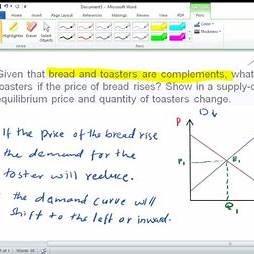
To analyze the impact of a rise in bread prices on the demand for toasters, we need to understand the relationship between these two goods. Bread and toasters are complementary goods, meaning they are often used together; as the consumption of one increases, so does the demand for the other. Therefore, if the price of bread rises, leading to a decrease in its consumption, the demand for toasters is likely to decrease as well.
Effect on the Demand Curve for Toasters:
An increase in the price of bread reduces consumers’ purchasing power, leading to a decline in the quantity of bread demanded. Consequently, the demand for toasters decreases because fewer people are purchasing bread. This decrease in demand is represented by a leftward shift of the toaster’s demand curve. At each price point, the quantity demanded for toasters is now lower than before.
Impact on Equilibrium Price and Quantity:
In a supply and demand diagram, the initial equilibrium is determined by the intersection of the supply and demand curves. When the demand curve shifts leftward due to decreased demand, the new equilibrium point moves to a lower quantity and, typically, a lower price. This shift reflects the reduced market demand for toasters following the bread price increase.
Diagram Explanation:
- Initial Equilibrium: The original demand curve (D1) intersects the supply curve (S) at the initial equilibrium price (P1) and quantity (Q1).
- Demand Shift: The demand curve shifts leftward to D2, indicating a decrease in demand.
- New Equilibrium: The new intersection of D2 and S occurs at a lower price (P2) and quantity (Q2), illustrating the market’s adjustment to the reduced demand.
Conclusion:
The rise in bread prices leads to a decrease in the demand for toasters, shifting the demand curve leftward. This shift results in a new equilibrium with a lower price and quantity for toasters. Understanding this relationship is crucial for manufacturers and retailers in anticipating market changes and adjusting their strategies accordingly.