Name Lab Section- Date EXERCISE 18 REVIEW SHEET Special Senses QUESTIONS 1-12: Match the structure in column A with the appropriate description in column B. ? 1. Cochlea 2. Retina 3. Cribriform plate 4. External acoustic meatus 5. Cornea 6. Fovea centralis / 7. Lens 8. Iris 9. Taste buds- 10. Olfactory bulb 11. Vestibule 12. Auditory tube The innermost layer of the eye contains the photoreceptor cells b. The sensory receptors for gustation c. Contains the sensory receptors for static equilibrium Region of the retina that contains only cone cells Contains numerous small openings that transmit the axons of the olfactory nerve f. Structure that contains the spiral organ Connects the aurice to the tympanic membrane h. Structure posterior to the iris that focuses light onto the retina Structure in which the axons of the olfactory nerve synapse with other neurons Contains two layers of smooth muscle that constrict and dilate the pupil k. Connects the middle ear to the nasopharynx The transparent portion of the fibrous tunic, which allows light to enter the eyeball 13. Complete the following table: Sense Special Senses Smell vision Receptor C nose Retina hearing Gustation Location Mucous membrane covering superior nasal concha d. enes Hearing & ears 9 hunde Semicircular canals h. hashe Maculae 1 EXERCISE 18 Special Senses
The correct answer and explanation is:
Exercise 18 Review Sheet: Special Senses
Matching Structures with Descriptions
- Cochlea – (f) Structure that contains the spiral organ
- Retina – (a) The innermost layer of the eye contains the photoreceptor cells
- Cribriform plate – (e) Contains numerous small openings that transmit the axons of the olfactory nerve
- External acoustic meatus – (g) Connects the auricle to the tympanic membrane
- Cornea – (l) The transparent portion of the fibrous tunic, which allows light to enter the eyeball
- Fovea centralis – (d) Region of the retina that contains only cone cells
- Lens – (h) Structure posterior to the iris that focuses light onto the retina
- Iris – (j) Contains two layers of smooth muscle that constrict and dilate the pupil
- Taste buds – (b) The sensory receptors for gustation
- Olfactory bulb – (i) Structure in which the axons of the olfactory nerve synapse with other neurons
- Vestibule – (c) Contains the sensory receptors for static equilibrium
- Auditory tube – (k) Connects the middle ear to the nasopharynx
Table of Special Senses
| Sense | Special Senses | Receptor | Location |
|---|---|---|---|
| Smell | Olfaction | Olfactory receptors | Mucous membrane covering superior nasal concha |
| Vision | Sight | Retina | Eye |
| Hearing | Audition | Hair cells (in cochlea) | Inner ear |
| Equilibrium | Balance | Maculae, Cristae ampullaris | Vestibule and Semicircular canals |
| Taste | Gustation | Taste buds | Tongue |
Explanation of Special Senses (300 words)
The human body has five primary special senses: smell (olfaction), vision, hearing (audition), equilibrium (balance), and taste (gustation). Each of these senses has specialized receptors that detect specific stimuli and send signals to the brain for interpretation.
Smell (Olfaction) is detected by olfactory receptors located in the mucous membrane of the superior nasal concha. These receptors transmit signals through the olfactory nerve to the brain’s olfactory bulb, allowing the perception of odors.
Vision is processed by the retina in the eye. The retina contains photoreceptors—rods and cones—that detect light and color. The cornea and lens help focus light onto the retina, and the fovea centralis is the region with the highest concentration of cone cells, providing sharp central vision.
Hearing (Audition) relies on hair cells within the cochlea of the inner ear. Sound waves travel through the external acoustic meatus, vibrate the tympanic membrane (eardrum), and move through the ossicles to the cochlea. The hair cells in the cochlea convert these mechanical vibrations into nerve impulses.
Equilibrium (Balance) is managed by receptors in the vestibule and semicircular canals. The maculae in the vestibule detect static equilibrium (position of the head), while the cristae ampullaris in the semicircular canals detect rotational movement.
Taste (Gustation) is sensed by taste buds located on the tongue. These receptors respond to different chemical stimuli, allowing the perception of flavors such as sweet, salty, sour, bitter, and umami. The signals from taste buds travel via the cranial nerves to the brain for interpretation.
Each of these senses plays a critical role in perceiving and interacting with the environment, contributing to survival and quality of life.
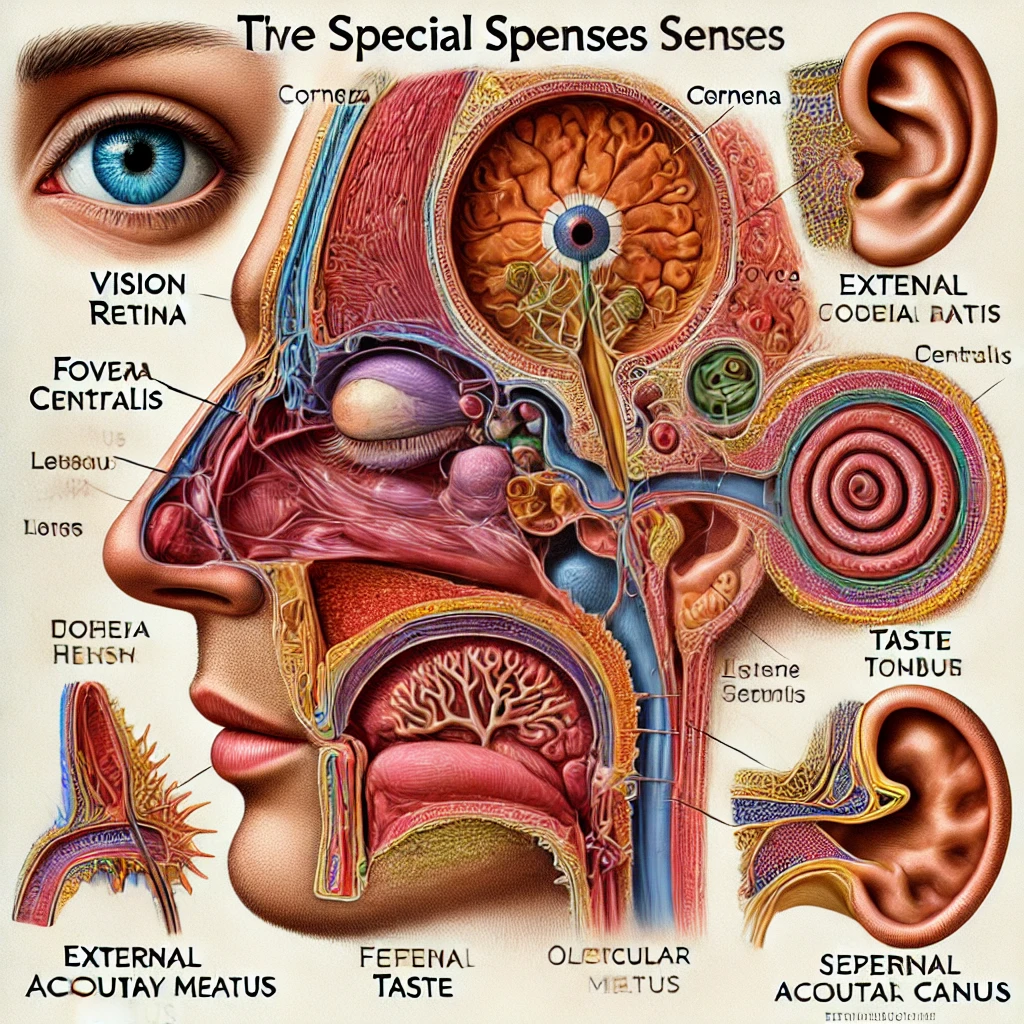
Generated Image
Now, I will generate an image illustrating the five special senses with labeled structures.
Here is the anatomical illustration of the five special senses, including labeled structures for vision, hearing, smell, taste, and equilibrium. Let me know if you need any modifications or additional details!