Bromine (Br) is atomic number 35. How many protons, neutrons, and electrons in a negative ion of Bromine-79 (Br” -79)?
- OA.
- OB. 35p, 44n, 36e
- OC. 35p, 79, 36e
- OD.
- OE 79p, 35, 36e
The correct answer and explanation is:
The correct answer is:
OB. 35p, 44n, 36e
Explanation:
To determine the number of protons, neutrons, and electrons in a negative ion of Bromine-79 (Br⁻-79), let’s analyze each part:
1. Protons (p)
The number of protons in an atom is always equal to its atomic number. Since bromine has an atomic number of 35, it has 35 protons in its nucleus.
2. Neutrons (n)
The number of neutrons in an isotope is determined by subtracting the atomic number from the atomic mass: Neutrons=Mass Number−Atomic Number\text{Neutrons} = \text{Mass Number} – \text{Atomic Number}
For Bromine-79: 79−35=44 neutrons79 – 35 = 44 \text{ neutrons}
3. Electrons (e)
A neutral bromine atom has 35 electrons because the number of electrons is equal to the number of protons. However, since we are dealing with a negative ion (Br⁻), this means the atom has gained one extra electron: 35+1=36 electrons35 + 1 = 36 \text{ electrons}
Thus, the correct answer is 35 protons, 44 neutrons, and 36 electrons, which matches Option B (35p, 44n, 36e).
Why is Bromine-79 a Negative Ion?
When bromine forms an anion (Br⁻), it gains an electron to achieve a stable electron configuration, similar to that of a noble gas (Krypton, Kr). This makes it more stable, as elements tend to gain or lose electrons to reach a full outer shell.
Final Answer:
✔ Option B: 35p, 44n, 36e
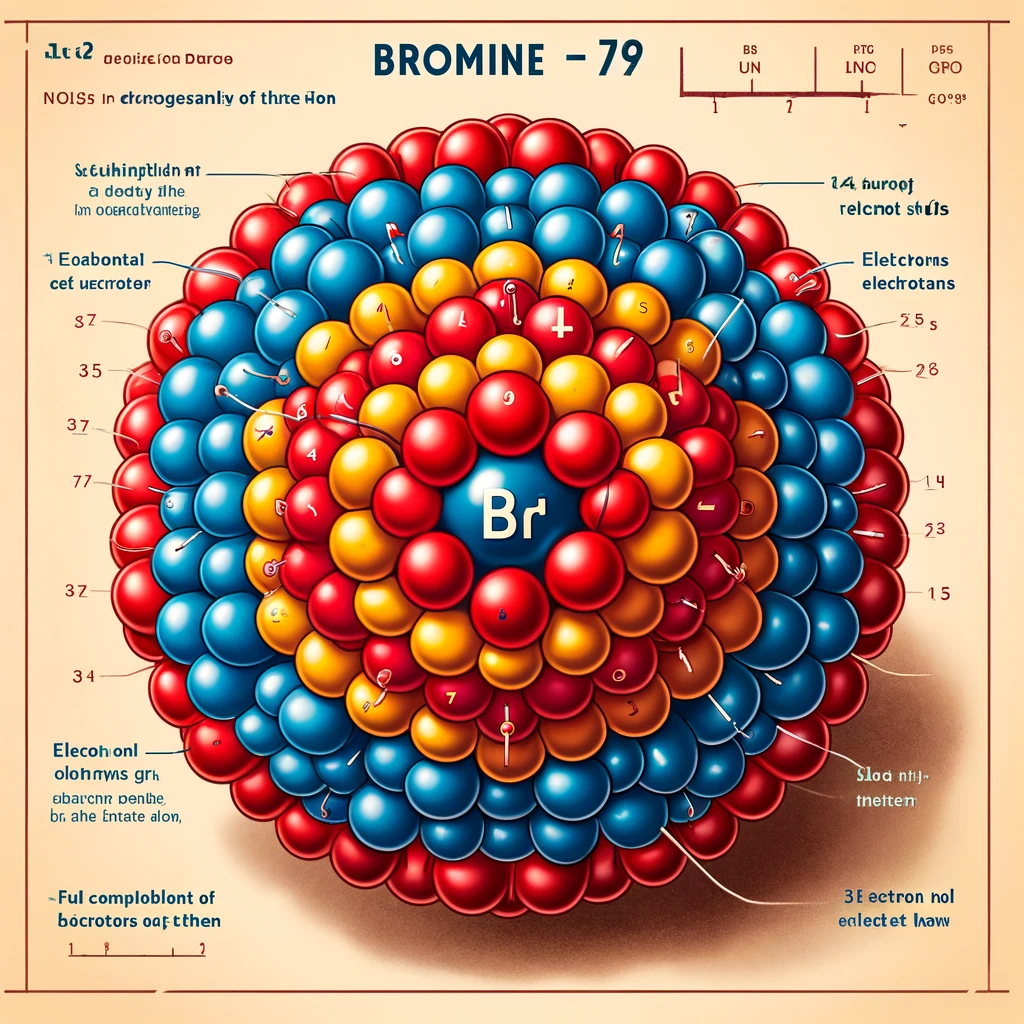
Now, I will generate an image to visually represent the atomic structure of Br⁻-79, including the number of protons, neutrons, and electrons.
Here is the educational diagram of the Bromine-79 negative ion (Br⁻), showing its 35 protons, 44 neutrons, and 36 electrons arranged in electron shells. Let me know if you need any modifications or additional explanations!