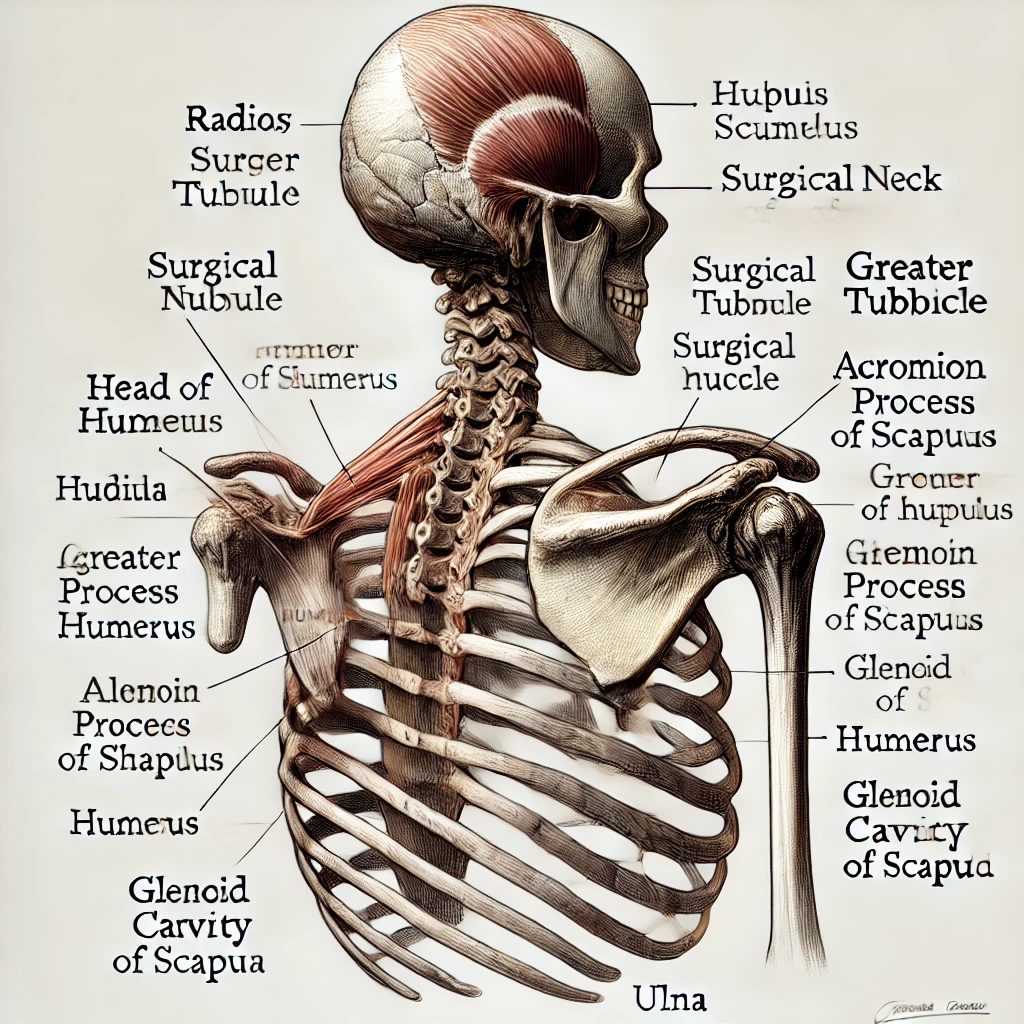
Label the bony structures of the shoulder and upper limb.
- Radius
- Scapula
- Surgical neck
- Head of humerus
- Greater tubercle
- Humerus
- Acromion process of scapula
- Glenoid cavity of scapula
- Ulna
The correct answer and explanation is:
The image above illustrates the key bony structures of the shoulder and upper limb. Here’s a detailed explanation of each labeled part:
- Radius: The radius is one of the two long bones of the forearm, located on the lateral side (thumb side) in the anatomical position. It is involved in wrist movement and supports the forearm’s rotation.
- Scapula: Also known as the shoulder blade, the scapula is a flat, triangular bone located on the back of the ribcage. It connects the humerus (upper arm bone) to the clavicle (collarbone).
- Surgical Neck: The surgical neck of the humerus is located just below the head of the humerus. It is a common site for fractures, especially in elderly individuals, due to the bone’s weakened structure.
- Head of Humerus: The rounded, ball-shaped part of the humerus that fits into the glenoid cavity of the scapula, forming the shoulder joint (glenohumeral joint). This ball-and-socket joint allows for a wide range of motion in the arm.
- Greater Tubercle: This is a bony prominence located on the lateral side of the humerus. It serves as an attachment point for the rotator cuff muscles, which are crucial for shoulder movement and stability.
- Humerus: The humerus is the long bone of the upper arm, extending from the shoulder to the elbow. It connects with both the scapula at the shoulder and the ulna and radius at the elbow.
- Acromion Process of Scapula: The acromion is a bony projection on the scapula, forming the highest point of the shoulder. It serves as an attachment point for the deltoid muscle and forms part of the acromioclavicular joint with the clavicle.
- Glenoid Cavity of Scapula: The shallow, cup-like structure in the scapula that receives the head of the humerus, creating the shoulder joint. It allows for a high degree of mobility but sacrifices stability.
- Ulna: The ulna is the longer of the two bones in the forearm, located on the medial (pinky) side. It plays a major role in the movement of the elbow joint.
This anatomical layout provides a comprehensive view of how these bones interact in the shoulder and upper limb.