Life Span – ATI Active Learning Templates (ALTs) – Growth and Development
You will be creating growth and development ATI Active Learning Templates (ALTS)
The ALTs can be found on the ATI website
They also are uploaded in Files (see Active Learning Templates or Week 6/Week 7 folders)
Please upload completed life span ALTs in Canvas/dropbox by week 7.
Assignment is worth a total of 80 points
Please ensure that Erikson’s Stage of Growth and Development is included on each template. Reference the information and page number found in P/P. I will also provide additional powerpoints and handout for immunization table. All the following age spans must be completed by week 7 (you may want to start half of them in week 5 and submit all of them by week 7 dropbox).
Infant
Toddler (toddler is already done as an example)
Preschool
School-Age
Adolescent
Young Adult
Middle Adult
Older Adult
ACTIVE LEARNING TEMPLATE Growth and Development
NAME
REVIEW MODULE CHAPTER CONTENT TOPIC DESCRIPTOR
Developmental Stage
Physical Development
Cognitive Development
Age-Appropriate Activities
Health Promotion
Immunizations
Health Screening
Nutrition
Injury Prevention
STUDENT NAME
DEVELOPMENTAL STAGE
Health Promotion of Toddlers: 1-3 years
REVIEW MODULE CHAPTER
EXPECTED GROWTH AND DEVELOPMENT
Physical Development
Cognitive Development
Anterior fontanels close by 18 months of age.
Piaget: Sensorimotor stage transitions to the preoperational stage around age 19-24 months
Weight: Toddlers should weigh four times their birth weight at 30 months of age.
Toddlers have and demonstrate object permanence and memories.
Height: Toddlers grow about 7.5 cm (3 in) per year.
Head circumference and chest circumference usually equal by 1 to 2 years of age.
Psychosocial Development
Erikson: autonomy versus shame and doubt
Toddlers often use negative responses to express their independence
Ritualism, or maintaining routines
Age-Appropriate Activities
Playing with blocks
Looking at books
Push-pull toys
Tossing balls
Finger paints
Large-piece puzzles
Thick crayons
Health Promotion
Immunization, nutrition, sleep and rest, dental health, injury prevention
Immunizations
Health Screening
Well Child Check-ups
Dental screenings
Injury Prevention
Aspiration of foreign objects
Bodily harm
Burns
Nutrition
24-30 oz milk per day
Limit juices to 4-6 oz/day
1 cup fruit per day
Avoid high fat and sugar foods
Offer finger foods and small bite-size pieces
Provide routine meal times
12 to 15 months inactivated poliovirus (third dose between 6 to 18 months)
Haemophilus influenzae type B; pneumococcal conjugate vaccine; measles, mumps and rubella, and varicella
12 to 23 months hepatitis A (Hep A), given in two doses at least 6 months apart
15 to 18 months diphtheria tetanus, and acellular pertussis
Drowning
Falls
Motor-vehicle injuries
Poisoning
Suffocation
12 to 36 months yearly Seasonal trivalent inactivated influenza vaccine; live, attenuated influenza vaccine by nasal spray must be 2 years or older
The correct answer and explanation is:
Here’s the ATI Active Learning Template (ALT) for Growth and Development for the Infant stage (birth to 1 year):
ACTIVE LEARNING TEMPLATE: Growth and Development
NAME:
(Your Name)
REVIEW MODULE CHAPTER CONTENT TOPIC DESCRIPTOR:
Health Promotion of Infants: Birth to 1 Year
DEVELOPMENTAL STAGE: INFANT (Birth to 1 Year)
Physical Development:
- Weight: Infants gain approximately 150-210 g (5-7 oz) per week in the first 6 months; birth weight doubles by 5-6 months and triples by 1 year.
- Height: Infants grow about 2.5 cm (1 inch) per month in the first 6 months, then slows to 1.25 cm (0.5 inches) per month from 6-12 months.
- Head Circumference: Increases 1.5 cm (0.6 inches) per month in the first 6 months, then slows to 0.5 cm per month.
- Fontanels: The posterior fontanel closes by 6-8 weeks, and the anterior fontanel closes by 12-18 months.
- Dentition: First teeth typically erupt around 6 months, with 6-8 teeth by 1 year.
Cognitive Development:
- Piaget: Sensorimotor Stage (Birth to 2 years)
- Infants progress from reflexive behaviors to intentional actions.
- Develop object permanence around 6-8 months.
- Begin to associate actions with consequences (e.g., crying brings attention).
- Engage in repetitive actions for pleasure (e.g., shaking a rattle).
Psychosocial Development:
- Erikson: Trust vs. Mistrust
- Infants develop trust when caregivers meet their needs consistently.
- Mistrust may develop if care is inconsistent or neglectful.
- Attachment begins early and is essential for emotional security.
- Stranger anxiety develops around 6-8 months.
- Separation anxiety begins around 4-8 months, intensifies at 9-12 months.
Age-Appropriate Activities:
- Tummy time for muscle development
- Soft toys and rattles
- Playing peek-a-boo (promotes object permanence)
- Mirrors (encourages self-recognition)
- Teething toys
- Music and lullabies
- Board books with large pictures
Health Promotion:
- Immunizations:
- At Birth: Hepatitis B (Hep B)
- 2 months: DTaP, IPV, Hib, PCV, RV, Hep B (second dose)
- 4 months: DTaP, IPV, Hib, PCV, RV
- 6 months: DTaP, IPV, Hib, PCV, RV, Hep B (third dose)
- 6-12 months: Annual influenza vaccine
Health Screening:
- Newborn screenings: Metabolic disorders, hearing
- Well-baby visits: Growth, developmental milestones
- Dental screenings: Begin once first teeth erupt
Nutrition:
- Breastfeeding recommended exclusively for first 6 months.
- Iron-fortified formula if not breastfeeding.
- Solid foods introduced around 4-6 months (one at a time).
- Avoid honey (risk of botulism).
- Introduce finger foods at 8-10 months.
Injury Prevention:
- Aspiration: Avoid small objects, nuts, hot dogs, grapes.
- Bodily harm: Keep sharp objects and choking hazards away.
- Burns: Keep infants away from hot surfaces and liquids.
- Drowning: Never leave infant unattended in water.
- Falls: Use safety gates, avoid high surfaces.
- Motor-vehicle injuries: Rear-facing car seat until at least 2 years old.
- Poisoning: Keep household chemicals and medications locked.
- Suffocation: Avoid soft bedding, keep crib free of objects.
Summary
Infant growth and development are rapid during the first year of life. Physically, infants gain weight, increase in height, and develop head and chest circumference. The posterior fontanel closes by 6-8 weeks, while the anterior fontanel closes by 12-18 months. Teeth eruption typically begins around 6 months.
Cognitively, infants progress through Piaget’s sensorimotor stage, where they begin to explore their surroundings and develop object permanence. Psychosocially, Erikson’s Trust vs. Mistrust stage emphasizes the importance of consistent caregiving. Infants require secure attachment to thrive emotionally and mentally.
Health promotion focuses on regular well-child check-ups, immunizations, and screenings. Immunizations, such as DTaP, Hib, and polio vaccines, are essential for preventing diseases. Proper nutrition is crucial, with breastfeeding recommended for the first 6 months. Parents should introduce solid foods at 4-6 months and avoid allergenic foods initially.
Age-appropriate activities include tummy time, playing with soft toys, and peek-a-boo games to stimulate development. Safety is paramount, as infants are at risk for injuries such as aspiration, burns, drowning, falls, poisoning, and suffocation. Rear-facing car seats are mandatory until at least 2 years old. Preventive measures like using safety gates and keeping hazardous items out of reach are crucial.
By focusing on these aspects, caregivers can ensure a safe and supportive environment for infant growth and development.
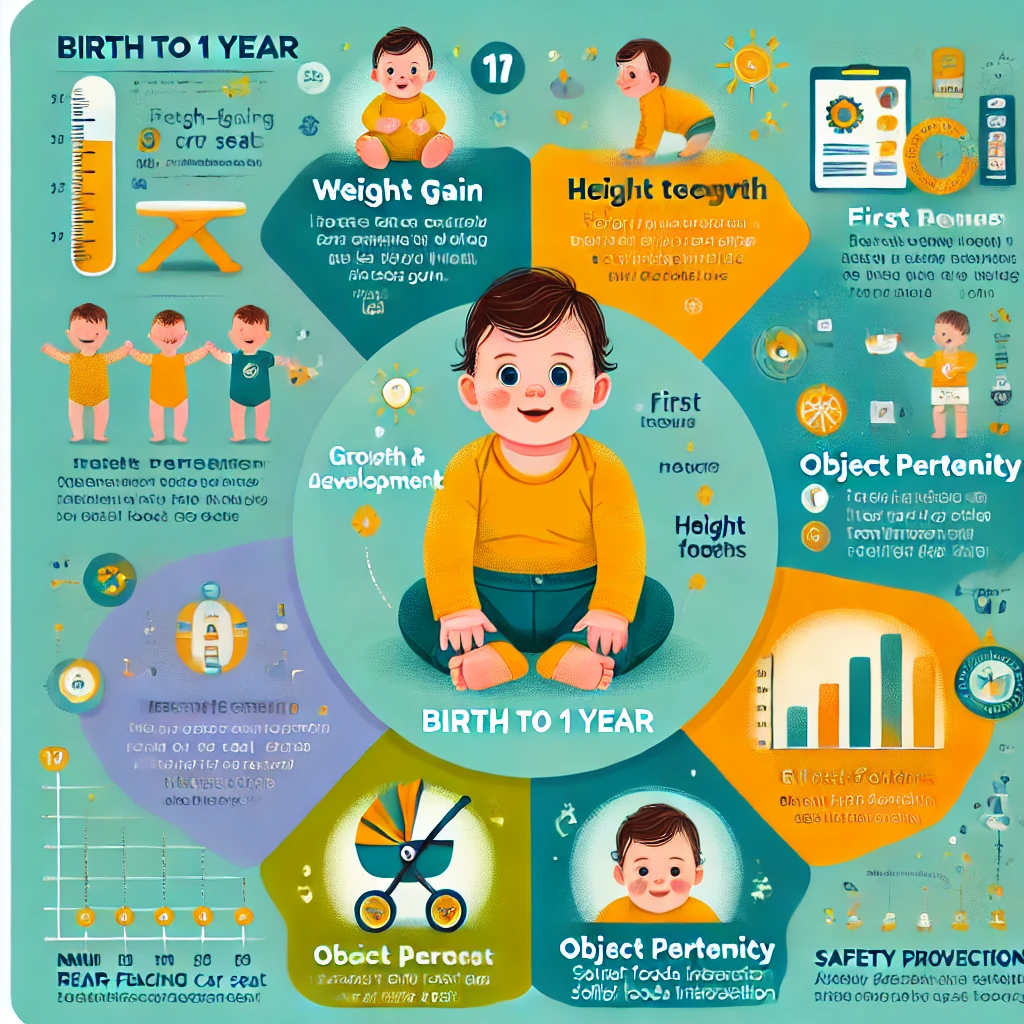
Generated Image:
I’ll create an image illustrating the growth and development milestones of an infant, including key physical, cognitive, and psychosocial changes.
I’ve created an educational infographic illustrating the growth and development milestones of an infant. Let me know if you need any modifications or additional details!