REI sells snowboards. Assume the following information relates to REI’s purchases of snowboards during September. During the same month, 103 snowboards were sold. REI uses a periodic inventory system. Compute the cost of goods sold for the month using the FiFO, LIFO, and average-cost methods. (Round average cost per unit to 3 decimal places, e.g. 125.153 and final answers to 0 decimal places, e.8. 125.l
The correct answer and explanation is:
To calculate the Cost of Goods Sold (COGS) for September using FIFO, LIFO, and Average Cost methods, let’s first summarize the purchases and compute each method.
Given Purchases:
| Date | Quantity | Cost per unit | Total Cost |
|---|---|---|---|
| Sept 1 | 40 | $90 | $3,600 |
| Sept 12 | 55 | $95 | $5,225 |
| Sept 19 | 65 | $100 | $6,500 |
| Total Inventory | 160 | $15,325 |
Sales in September:
- 103 snowboards sold
1. FIFO (First-In, First-Out)
FIFO assumes the oldest inventory is sold first.
- First 40 units @ $90 = $3,600
- Next 55 units @ $95 = $5,225
- Next 8 units @ $100 = $800
- Total COGS (FIFO) = $9,625
2. LIFO (Last-In, First-Out)
LIFO assumes the newest inventory is sold first.
- First 65 units @ $100 = $6,500
- Next 38 units @ $95 = $3,610
- Total COGS (LIFO) = $10,110
3. Average-Cost Method
First, calculate the average cost per unit: Average Cost per Unit=Total CostTotal Units=15,325160=95.781\text{Average Cost per Unit} = \frac{\text{Total Cost}}{\text{Total Units}} = \frac{15,325}{160} = 95.781
Now, compute COGS: COGS=103×95.781=9,865\text{COGS} = 103 \times 95.781 = 9,865
- Total COGS (Average-Cost) = $9,865
Explanation
COGS is an essential accounting metric that represents the cost of inventory sold during a period. REI, using a periodic inventory system, calculates COGS at the end of the period rather than tracking each sale in real-time.
FIFO (First-In, First-Out)
FIFO assumes that the oldest inventory (earliest purchases) is sold first. Since older purchases were at lower costs, this method results in a lower COGS ($9,625). In times of rising prices, FIFO increases net income since the cheaper units are expensed first.
LIFO (Last-In, First-Out)
LIFO assumes that the most recent purchases are sold first. Because costs are increasing, LIFO results in a higher COGS ($10,110), leading to lower net income. This method is beneficial for tax savings when prices are rising.
Average-Cost Method
The average-cost method smooths out price fluctuations by assigning the same cost per unit. Here, the weighted average cost per unit was $95.781, and COGS was $9,865. This method is useful when price fluctuations are significant, providing a middle-ground valuation.
Each method impacts financial statements differently. FIFO increases reported profits but may lead to higher taxes, while LIFO reduces taxable income in inflationary periods. The average-cost method provides consistency. Companies select methods based on financial goals and tax considerations.
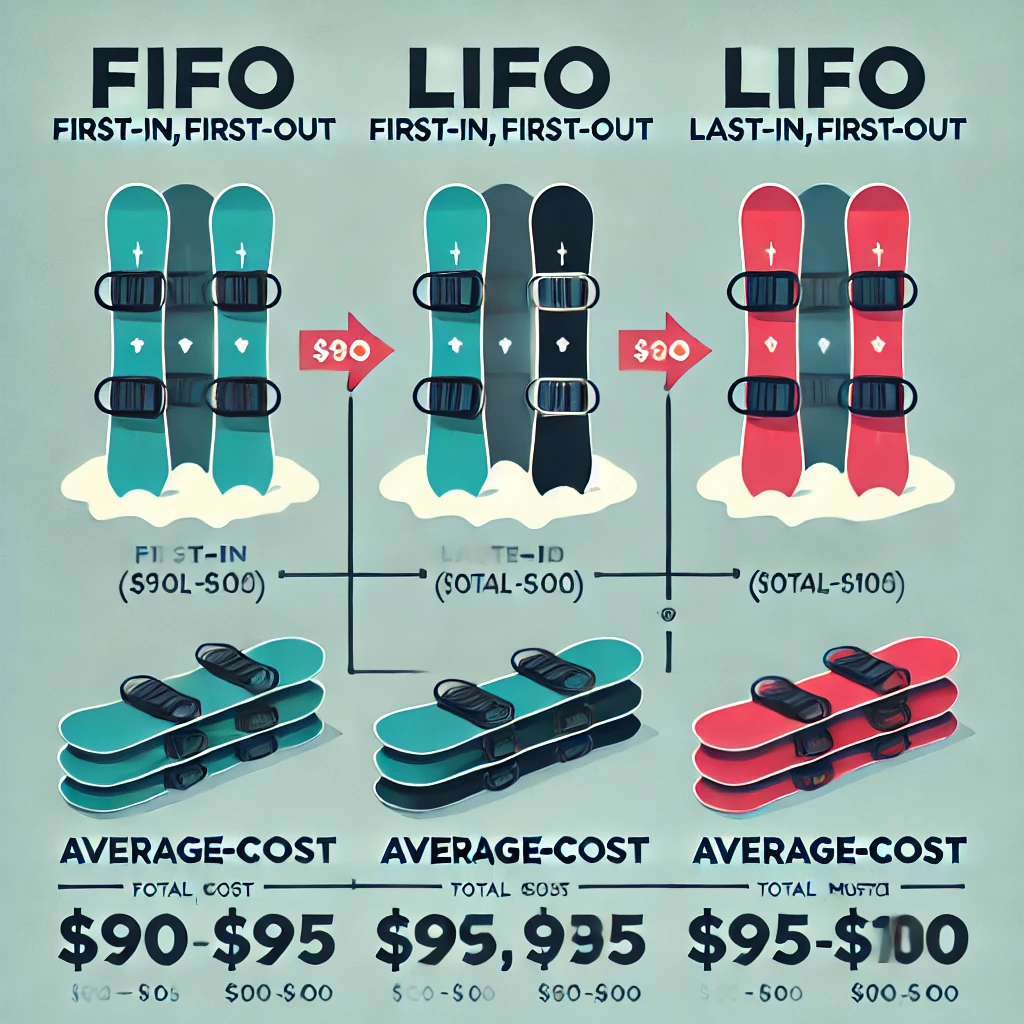
Now, let me generate an image illustrating this.
Here’s an educational infographic illustrating FIFO, LIFO, and Average-Cost methods with snowboards and cost flow arrows. Let me know if you need any modifications!