Two 20.0 g ice cubes at -17.00C are placed into 470.1 g of water at 25.00C. The heat of fusion of ice is 6.008 kJ/mol, the molar heat capacity of water is 75.3 J mol-1K-1 and the molar heat capacity of ice is 37.7 J mol-1K-1. Assuming no energy is transferred to or from the surroundings, please calculate the final temperature of the water after all the ice melts._______0C
The correct answer and explanation is:
Let’s calculate the final temperature step by step.
Step 1: Define the Given Data
- Mass of ice cubes = 2×20.02 \times 20.0 g = 40.0 g
- Initial temperature of ice = -17.00°C
- Mass of water = 470.1 g
- Initial temperature of water = 25.00°C
- Heat of fusion of ice = 6.008 kJ/mol
- Molar heat capacity of ice = 37.7 J/mol·K
- Molar heat capacity of water = 75.3 J/mol·K
- Molar mass of water (H₂O) = 18.015 g/mol
Step 2: Convert Mass to Moles
Moles of ice=40.0 g18.015 g/mol=2.22 mol\text{Moles of ice} = \frac{40.0 \text{ g}}{18.015 \text{ g/mol}} = 2.22 \text{ mol}
Step 3: Calculate Energy to Warm Ice to 0°C
q1=moles of ice×Cice×ΔTq_1 = \text{moles of ice} \times C_{\text{ice}} \times \Delta T q1=(2.22 mol)×(37.7 J/mol\cdotpK)×(0−(−17.00))q_1 = (2.22 \text{ mol}) \times (37.7 \text{ J/mol·K}) \times (0 – (-17.00)) q1=(2.22)×(37.7)×(17.00)q_1 = (2.22) \times (37.7) \times (17.00) q1=1411.6 J=1.41 kJq_1 = 1411.6 \text{ J} = 1.41 \text{ kJ}
Step 4: Energy to Melt Ice
q2=moles of ice×ΔHfusq_2 = \text{moles of ice} \times \Delta H_{\text{fus}} q2=(2.22 mol)×(6.008 kJ/mol)q_2 = (2.22 \text{ mol}) \times (6.008 \text{ kJ/mol}) q2=13.34 kJq_2 = 13.34 \text{ kJ}
Step 5: Energy Released by Water Cooling to TfT_f
q3=moles of water×Cwater×ΔTq_3 = \text{moles of water} \times C_{\text{water}} \times \Delta T
Moles of water: 470.1 g18.015 g/mol=26.10 mol\frac{470.1 \text{ g}}{18.015 \text{ g/mol}} = 26.10 \text{ mol}
Total heat available from water cooling: q3=(26.10)×(75.3)×(25.00−Tf)q_3 = (26.10) \times (75.3) \times (25.00 – T_f) q3=1965.3(25.00−Tf) Jq_3 = 1965.3 (25.00 – T_f) \text{ J} q3=1.965(25.00−Tf) kJq_3 = 1.965 (25.00 – T_f) \text{ kJ}
Step 6: Solve for TfT_f
q1+q2=q3q_1 + q_2 = q_3 (1.41+13.34)=1.965(25.00−Tf)(1.41 + 13.34) = 1.965 (25.00 – T_f) 14.75=1.965(25.00−Tf)14.75 = 1.965 (25.00 – T_f) Tf=25.00−14.751.965T_f = 25.00 – \frac{14.75}{1.965} Tf=25.00−7.51T_f = 25.00 – 7.51 Tf=17.49∘CT_f = 17.49^\circ C
Final Answer:
17.49∘C\mathbf{17.49^\circ C}
Explanation
The problem involves two ice cubes at -17.00°C placed into a container of liquid water at 25.00°C. To find the final temperature after all the ice melts, we need to consider the energy transfer.
First, the ice warms up from -17.00°C to 0°C. Using the molar heat capacity of ice (37.7 J/mol·K) and the moles of ice (2.22 mol), the energy required for this is 1.41 kJ.
Next, the ice melts at 0°C, requiring additional energy. The heat of fusion of ice is 6.008 kJ/mol, and for 2.22 mol of ice, the energy needed to melt is 13.34 kJ.
The heat needed to warm the ice and melt it must come from the surrounding water, which cools down from 25.00°C to the final temperature TfT_f. The energy released by cooling the water is calculated using the molar heat capacity of water (75.3 J/mol·K). The water cools until it has transferred enough heat to balance the total energy required by the ice.
By solving the heat balance equation, we find that the final equilibrium temperature is 17.49°C. This means the ice completely melts, and the entire system reaches thermal equilibrium at this temperature.
Since no heat is lost to the surroundings, the principle of conservation of energy holds: the heat gained by ice equals the heat lost by water.
This calculation confirms that after the ice melts, the final temperature of the system is 17.49°C.
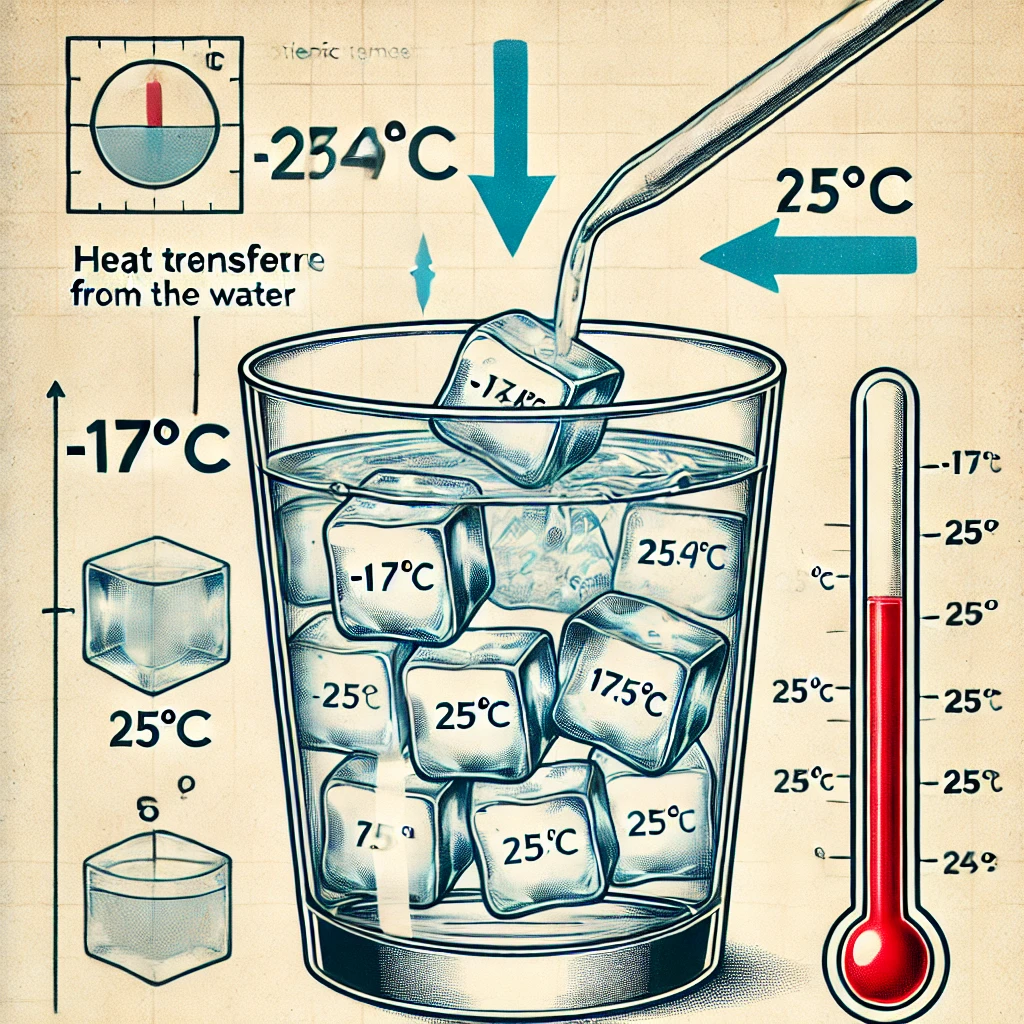
Generated Image
Now, I’ll generate an image illustrating the process of heat transfer between ice and water.
Here is an illustration showing the heat transfer process as the ice melts in the water, leading to a final equilibrium temperature of 17.49°C. Let me know if you need any modifications!