4. Active transport is like facilitated diffusion in that both processes A. move molecules down their concentration gradient B. require the presence of carrier proteins in the plasma membrane C. do not require a source of energy 5. You know that potassium levels inside the cell are kept higher than in the interstitial fluid. To have a movement of potassium into a cell will require A. high cellular concentrations of calcium. B. ATP of carrier proteins. C. low cellular concentrations of sodium. 6. Both facilitated diffusion and active transport use carrier proteins for transport across the membrane but they differ in that A. ATP is necessary for active transport, but not for facilitated diffusion. B. facilitated diffusion moves water across the cell membrane, whereas active transport does not. C. facilitated diffusion uses cell membrane proteins to move substances, whereas active transport does not.
The correct answer and explanation is:
Correct Answers:
- B. require the presence of carrier proteins in the plasma membrane
- B. ATP of carrier proteins
- A. ATP is necessary for active transport, but not for facilitated diffusion
Explanation:
Active Transport vs. Facilitated Diffusion
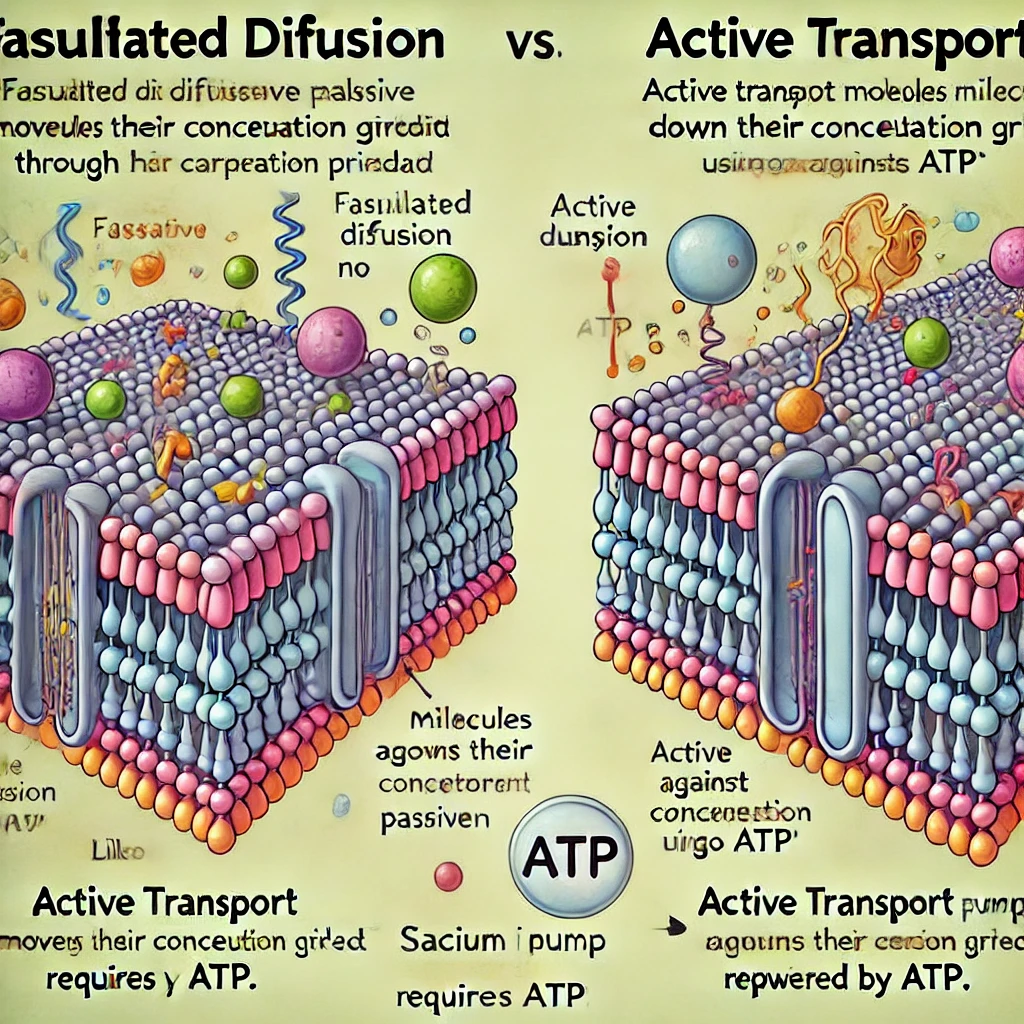
Both active transport and facilitated diffusion involve the movement of molecules across the cell membrane with the help of carrier proteins. However, facilitated diffusion is a passive process that moves molecules down their concentration gradient (from high to low concentration) without requiring energy. In contrast, active transport moves molecules against their concentration gradient (from low to high concentration), which requires ATP.
Facilitated diffusion is essential for transporting substances like glucose and amino acids across the membrane, using specialized transport proteins. On the other hand, active transport is used when the cell needs to maintain an unequal concentration of ions, such as sodium (Na⁺) and potassium (K⁺), which are regulated by the sodium-potassium pump (Na⁺/K⁺ ATPase).
Potassium Movement in Cells
Potassium (K⁺) levels inside the cell are kept higher than in the interstitial fluid. Since potassium naturally diffuses out of the cell, moving it back in requires active transport using the Na⁺/K⁺ pump, which depends on ATP. The pump exchanges three sodium ions (Na⁺) out of the cell for two potassium ions (K⁺) into the cell. This process is critical for maintaining cell function, including nerve signal transmission and muscle contractions.
Overall, the key difference between facilitated diffusion and active transport is energy use: facilitated diffusion is passive, while active transport requires ATP. Without these transport mechanisms, cells wouldn’t be able to regulate essential ions and nutrients properly.
Now, I’ll generate an image illustrating these transport processes.
Here is an educational diagram comparing facilitated diffusion and active transport. It illustrates how facilitated diffusion moves molecules passively, while active transport requires ATP to move substances against their concentration gradient. Let me know if you need any modifications!