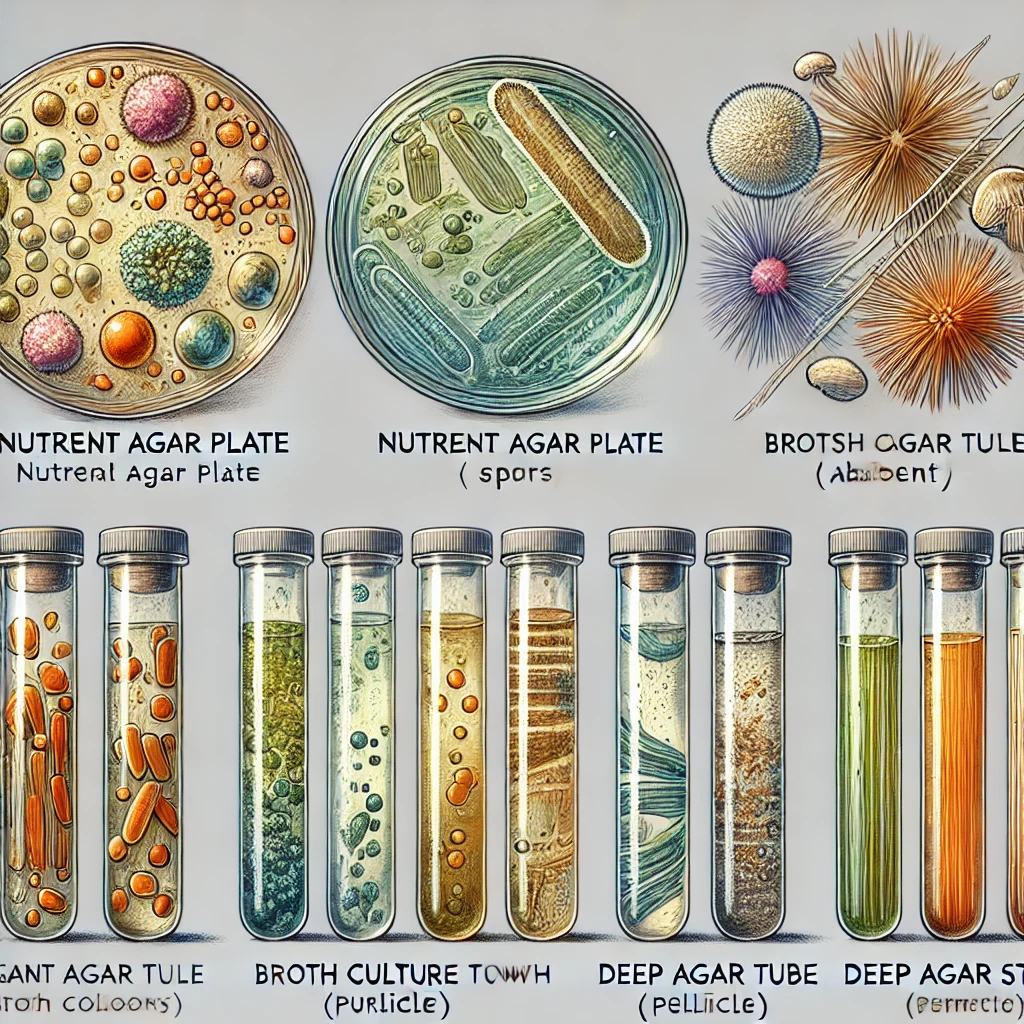
Date Lab Section DATA SHEET 1-4 I Was Present And Performed This Exercise Initials – Common Aseptic Transfers And Inoculation Methods OBSERVATIONS AND INTERPRETATIONS 1 Describe The Appearance Of Growth Orvin Each Medium. Growth On A Solid Medium Could Be Described By Color And Amount (Abundant, Sparse, Absent). Draw Representative Samples Of Each Growth
The correct answer and explanation is:
Here’s a structured response to your request:
Observations and Interpretations of Aseptic Transfers and Inoculation Methods
Growth Observations:
- Nutrient Agar Plate (Solid Medium)
- Appearance: Colonies appear opaque, creamy, or pigmented depending on the bacterial species. Growth may be abundant, sparse, or absent depending on inoculation technique and bacterial viability.
- Interpretation: Abundant growth suggests successful inoculation, while sparse or absent growth could indicate poor technique or non-viable bacteria.
- Broth Culture (Liquid Medium)
- Appearance: Growth is seen as turbidity (cloudiness) throughout, sediment at the bottom, or a pellicle at the surface.
- Interpretation: Uniform turbidity suggests facultative anaerobes, pellicle formation indicates aerobic bacteria, and sediment points to anaerobic or heavy bacteria.
- Slant Agar Culture
- Appearance: Growth appears as a streak line, with a dense or sparse spread. Some bacteria may produce pigments.
- Interpretation: A thick streak suggests robust bacterial growth, while a faint streak indicates minimal growth.
- Deep Agar Culture
- Appearance: Growth along the stab line, possibly with spreading.
- Interpretation: Growth at the top suggests aerobic bacteria, while deep growth indicates anaerobic adaptation.
Explanation
Aseptic transfer and inoculation methods are crucial in microbiology to prevent contamination and ensure accurate observations. Growth on solid media such as nutrient agar plates is assessed by colony morphology, pigmentation, and density. Different bacteria produce distinct colonies—smooth, rough, filamentous, or mucoid. Pigmentation, such as yellow for Micrococcus luteus or green for Pseudomonas aeruginosa, helps identification.
Broth cultures show turbidity patterns indicating bacterial oxygen requirements. Facultative anaerobes, such as Escherichia coli, grow uniformly, while obligate aerobes like Bacillus subtilis form a pellicle.
On slant agar, growth intensity and pigmentation help identify species. Certain bacteria, such as Serratia marcescens, produce red pigments, aiding identification.
Deep agar stabs determine oxygen needs—strict aerobes grow at the surface, while anaerobes remain deep in the stab line.
Proper aseptic techniques like flaming the inoculating loop, using sterile pipettes, and minimizing exposure to airborne contaminants ensure accurate results. These methods are foundational in clinical diagnostics, research, and biotechnology.
Now, I will generate an image illustrating these bacterial growth patterns.
Here is the scientific illustration depicting bacterial growth patterns in different culture media. Let me know if you need any modifications or further explanations!