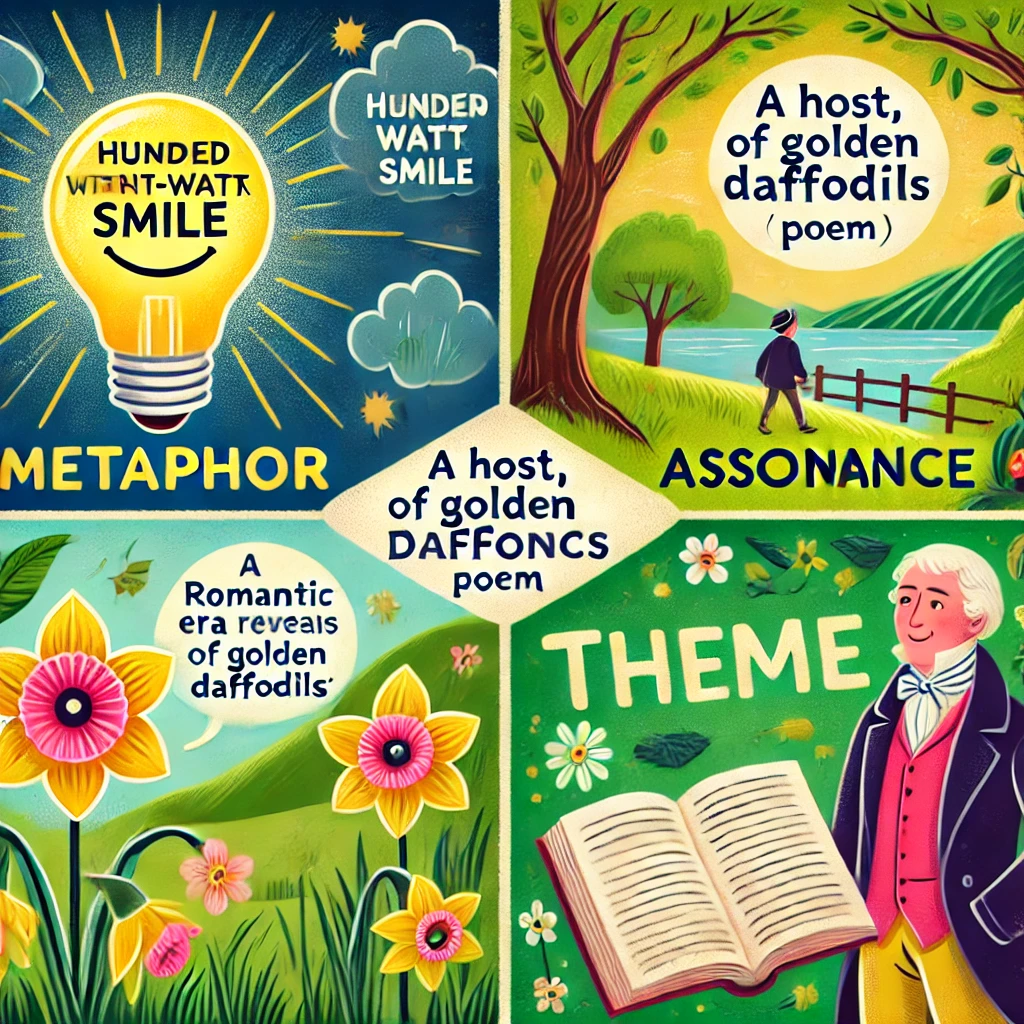
1. Which of these lines contains a metaphor?
- A. You are like a sun to me.
- B. Like unto death was her countenance.
- C. She offered him a hundred-watt smile.
- D. Now is your final hour.
2. The repeated use of the “o” sound in “A host, of golden daffodils” is called
- A. alliteration.
- B. consonance.
- C. rhyme.
- D. assonance.
3. During the Romantic period, poets placed an emphasis on
- A. nature.
- B. order.
- C. discipline.
- D. hierarchy.
4. Beyond tone, a poet’s attitude toward his or her subject reveals to us a poem’s
- A. theme.
- B. Structure.
- C. Subject
- D. Diction.
The correct answer and explanation is:
Here are the correct answers to your questions:
- C. She offered him a hundred-watt smile.
- D. Assonance.
- A. Nature.
- A. Theme.
Explanation:
- Metaphor – “She offered him a hundred-watt smile.”
A metaphor is a figure of speech that directly compares two unlike things without using “like” or “as.” In this case, the phrase “hundred-watt smile” compares a bright smile to a powerful lightbulb. Unlike the other options, which use similes (comparison using “like” or “as”) or metaphorical language that isn’t a direct metaphor, this line clearly embodies a metaphor. - Assonance – “A host, of golden daffodils.”
Assonance is the repetition of vowel sounds in nearby words. In this case, the “o” sound in “host” and “golden” creates a harmonious effect. It differs from alliteration, which involves the repetition of consonant sounds at the beginning of words, and consonance, which involves repeating consonant sounds anywhere in words. - Romanticism and Nature
The Romantic period (late 18th to mid-19th century) emphasized emotion, individualism, and a deep connection to nature. Poets like William Wordsworth and John Keats found inspiration in natural landscapes, using them to express emotions and philosophical ideas. Unlike the preceding Neoclassical period, which valued order and discipline, Romanticism celebrated nature’s wild beauty and human imagination. - Theme in Poetry
A poet’s tone and attitude toward the subject help reveal a poem’s theme, which is its underlying message or central idea. For example, a poem about a storm could symbolize chaos or renewal, depending on the poet’s tone. The structure, subject, and diction all contribute, but it is the theme that provides the deeper meaning.