_______sedimentary rocks form when chemicals in water come out the water and form solids.
a. Nonclastic
b. Clastic
c. Metamorphic
d. Igneous
The correct answer and explanation is :
The correct answer is a. Nonclastic.
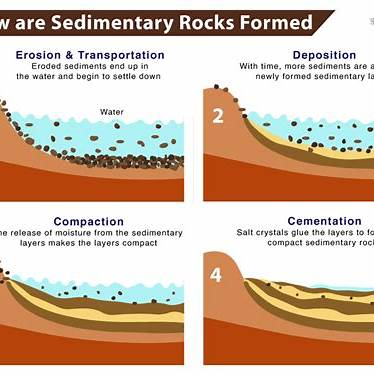
Sedimentary rocks are classified into three main categories based on their formation processes: clastic, chemical (nonclastic), and organic. Clastic sedimentary rocks form from the accumulation and lithification of physical fragments derived from pre-existing rocks, such as sandstone and shale. Organic sedimentary rocks, like coal, develop from the accumulation of plant or animal debris. Chemical sedimentary rocks, also known as nonclastic rocks, originate from the precipitation of minerals dissolved in water.
Nonclastic sedimentary rocks form when minerals precipitate from a solution due to processes like evaporation or chemical reactions. For instance, when water bodies like lakes or shallow seas evaporate under arid conditions, the concentration of dissolved minerals increases until they reach saturation and begin to crystallize, settling out of the solution. This process leads to the formation of mineral deposits such as halite (rock salt) and gypsum. These minerals accumulate over time, compact, and cement together to form nonclastic sedimentary rocks. The term “nonclastic” distinguishes these rocks from clastic sedimentary rocks, which are composed of fragments or clasts of pre-existing rocks.
An example of a nonclastic sedimentary rock is rock salt, primarily composed of halite. Rock salt forms in environments where evaporation rates are high, such as restricted basins in hot climates, leading to the precipitation of salt minerals. Another example is gypsum rock, which forms similarly through the evaporation of sulfate-rich waters, resulting in the deposition of gypsum minerals. These processes illustrate how chemical sedimentary rocks record the chemical conditions of their environment at the time of their formation, providing valuable insights into Earth’s geologic history.