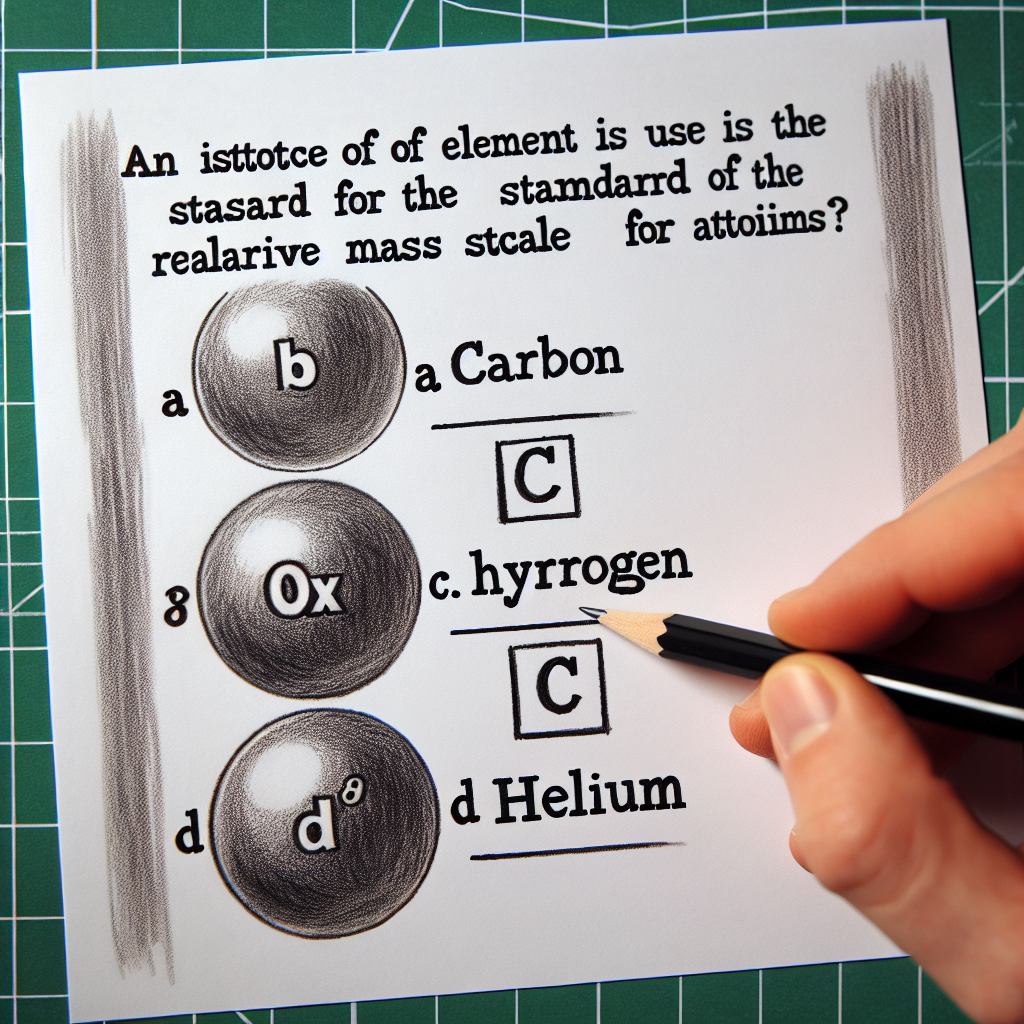
An isotope of which element is used as the standard for the relative mass scale for atoms?
A) carbon
B) oxygen
C) hydrogen
D) helium
The correct answer and explanation is :
The correct answer is A) carbon.
The standard for the relative mass scale of atoms is based on the isotope carbon-12 (C-12). This choice was made due to the isotope’s stability and its abundance in nature. The atomic mass unit (amu), also known as the unified atomic mass unit (u), is defined as 1/12th the mass of a single carbon-12 atom.
Explanation:
The concept of atomic mass is crucial in chemistry and physics, as it provides a way to quantify the mass of atoms and molecules. The relative atomic mass is the ratio of the mass of an atom to 1/12th the mass of a carbon-12 atom, which has been set as the standard reference.
The carbon-12 isotope was chosen as the standard for a few key reasons:
- Stability: Carbon-12 is a stable isotope, meaning it doesn’t decay over time, which makes it reliable as a reference.
- Abundance: Carbon is a naturally abundant element in the universe, especially in organic compounds, which makes carbon-12 widely available for scientific measurements.
- Historical Importance: Before the adoption of carbon-12, hydrogen (specifically the isotope protium, which is just a single proton) was considered as a reference, but it was decided that carbon-12 offered a more practical and precise standard for atomic mass measurements.
The choice of carbon-12 also helps avoid the complications associated with isotopes like oxygen or helium, which have different abundances and decay patterns, and hydrogen, which has an atomic mass much smaller than carbon-12, leading to less convenient scaling for most elements.
Thus, when chemists and physicists refer to the atomic mass of elements, they are referring to the mass relative to the carbon-12 standard.