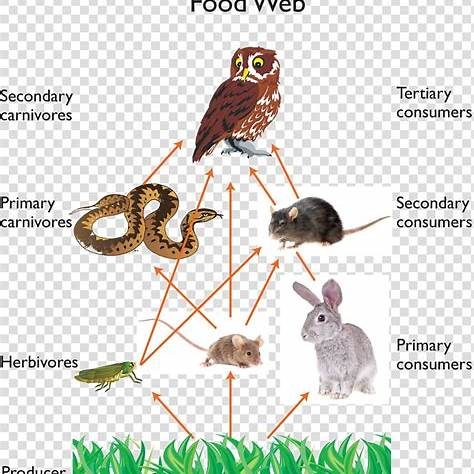
Owls are secondary consumers.
The producer – the grass and seeds.
The primary consumer – the mice that eat the seeds.
The secondary consumer – the owl that eats the mice.
The correct answer and explanation is :
You are absolutely correct! Here’s a detailed breakdown:
Producers are organisms that create their own food through photosynthesis or other processes. In this case, grass and seeds are the producers. Grass uses sunlight to produce food and provides an energy source for other organisms in the ecosystem.
Primary consumers are herbivores that feed on producers. In this food chain, mice are the primary consumers. They eat the seeds produced by the grass, gaining energy from the plant matter.
Secondary consumers are organisms that eat primary consumers. Owls are secondary consumers in this scenario. They hunt and eat mice, which are the primary consumers. Owls, being carnivores, rely on mice as their main food source.
Explanation:
In an ecosystem, energy flows in a sequence of feeding relationships known as a food chain. At the bottom of the chain are the producers, which provide the energy that sustains the other organisms. Producers, such as plants and seeds, convert solar energy into chemical energy, which is then transferred to consumers that feed on them.
The primary consumers (herbivores) then consume the producers. In this example, the mice are eating the seeds produced by the grass, acquiring energy from the plant material. The next level is the secondary consumers — organisms that feed on the primary consumers. Owls, as carnivores, eat the mice. Owls are the secondary consumers in this food chain.
Thus, the food chain flows like this:
- Grass and seeds (Producer) → Mice (Primary consumer) → Owls (Secondary consumer).
Each level in the food chain transfers energy, which is essential for the survival of organisms at higher levels.