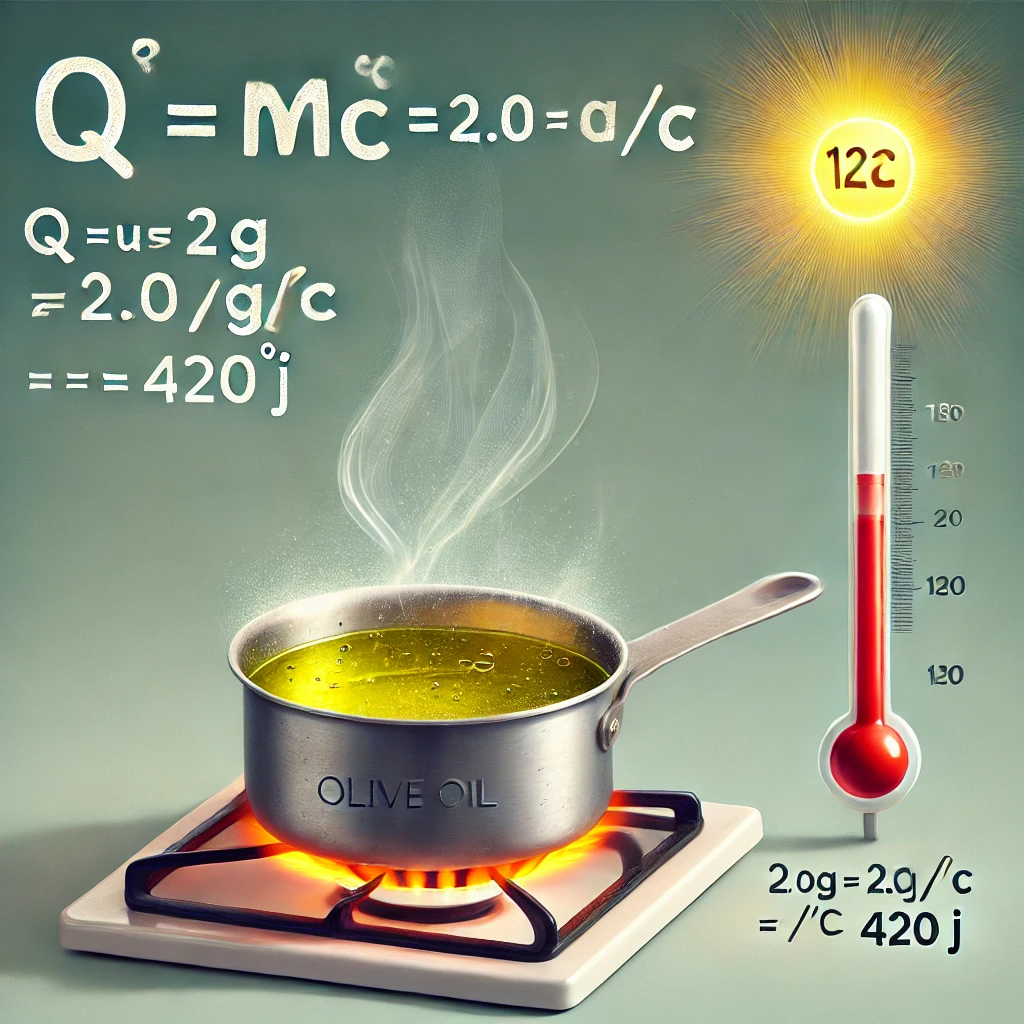
The specific heat capacity of Olive oil is 2.0 jewels over Grams times Celsius. how much energy has to be transferred to 2.0 g of Olive oil in a saucepan to keep it from Room temperature 25C to a 130C
I’m not sure how to execute this equation. any help is great!
The correct answer and explanation is:
To find the energy required to heat the olive oil, we use the specific heat equation: Q=mcΔTQ = mc\Delta T
Where:
- QQ = heat energy (in joules)
- mm = mass of the substance (in grams)
- cc = specific heat capacity (in J/g°C)
- ΔT\Delta T = change in temperature (Tfinal−TinitialT_{\text{final}} – T_{\text{initial}})
Given data:
- m=2.0m = 2.0 g
- c=2.0c = 2.0 J/g°C
- Tinitial=25∘CT_{\text{initial}} = 25^\circ C, Tfinal=130∘CT_{\text{final}} = 130^\circ C
- ΔT=130−25=105∘C\Delta T = 130 – 25 = 105^\circ C
Now, calculating the heat energy: Q=(2.0 g)×(2.0 J/g°C)×(105 °C)Q = (2.0 \, \text{g}) \times (2.0 \, \text{J/g°C}) \times (105 \, \text{°C}) Q=4.0×105=420 JQ = 4.0 \times 105 = 420 \, \text{J}
Explanation
The concept of specific heat capacity describes how much energy is needed to raise the temperature of a given mass of a substance by 1°C. In this case, olive oil has a specific heat capacity of 2.0 J/g°C, meaning it takes 2.0 joules of energy to increase the temperature of 1 gram of olive oil by 1°C.
To determine the total energy required, we use the formula Q=mcΔTQ = mc\Delta T. The mass of the olive oil is 2.0 g, and the temperature change (ΔT\Delta T) is calculated as the difference between the final and initial temperatures:
130∘C−25∘C=105∘C130^\circ C – 25^\circ C = 105^\circ C.
By multiplying these values together, we find that 420 joules of energy must be transferred to heat the olive oil to the desired temperature. This means that the saucepan must provide at least 420 J of heat energy to ensure the oil reaches 130°C from room temperature (25°C).
This principle is essential in cooking, heating, and even understanding how different materials respond to heat. Olive oil has a relatively high specific heat capacity compared to metals, meaning it heats up more slowly but retains heat longer. This is why oil is commonly used in cooking—it distributes heat evenly and maintains temperature.
Now, I’ll generate an image illustrating this concept.
I’ve provided the scientific illustration showing the saucepan, temperature change, and the heat energy calculation. Let me know if you need any modifications!