WHAT IS 5pi/16 IN DEGREES?
The correct answer and explanation is :
To convert the angle ( \frac{5\pi}{16} ) radians to degrees, we can use the following conversion factor:
[ 1 \text{ radian} = \frac{180}{\pi} \text{ degrees} ]
Applying this conversion factor:
[ \frac{5\pi}{16} \times \frac{180}{\pi} = \frac{5 \times 180}{16} = \frac{900}{16} = 56.25^\circ ]
Therefore, ( \frac{5\pi}{16} ) radians is equal to 56.25 degrees.
Understanding Radians and Degrees:
Angles can be measured in two primary units: degrees and radians. Degrees are a more intuitive unit for many people, dividing a full circle into 360 equal parts. In contrast, radians are based on the radius of a circle and are often used in higher mathematics, especially in calculus and trigonometry.
Radians:
A radian is defined as the angle subtended at the center of a circle by an arc whose length is equal to the radius of the circle. This means that the angle in radians is the ratio of the length of the arc to the radius. One full revolution around a circle corresponds to ( 2\pi ) radians, which is equivalent to 360 degrees.
Degrees:
Degrees divide a full circle into 360 equal parts. This system dates back to ancient civilizations and is still widely used in everyday applications. One full revolution is 360 degrees, so a right angle is 90 degrees, and a straight angle is 180 degrees.
Conversion Between Radians and Degrees:
To convert an angle from radians to degrees, multiply the radian measure by ( \frac{180}{\pi} ). Conversely, to convert from degrees to radians, multiply the degree measure by ( \frac{\pi}{180} ).
Visualizing the Angle:
To visualize ( \frac{5\pi}{16} ) radians (or 56.25 degrees), consider the unit circle—a circle with a radius of 1 centered at the origin of a coordinate plane. Angles in standard position start along the positive x-axis. An angle of 56.25 degrees (or ( \frac{5\pi}{16} ) radians) represents a counterclockwise rotation from the positive x-axis.
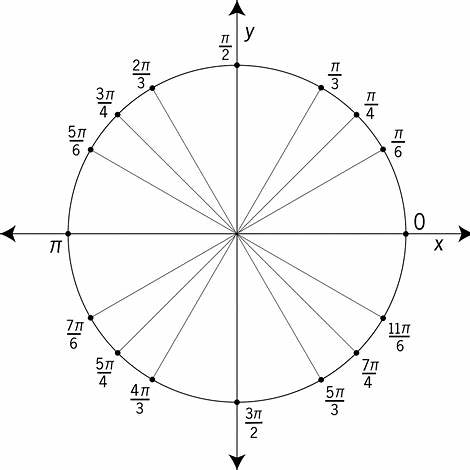
Understanding these concepts and the relationship between radians and degrees is fundamental in trigonometry and calculus, where the radian measure simplifies many mathematical expressions and calculations.