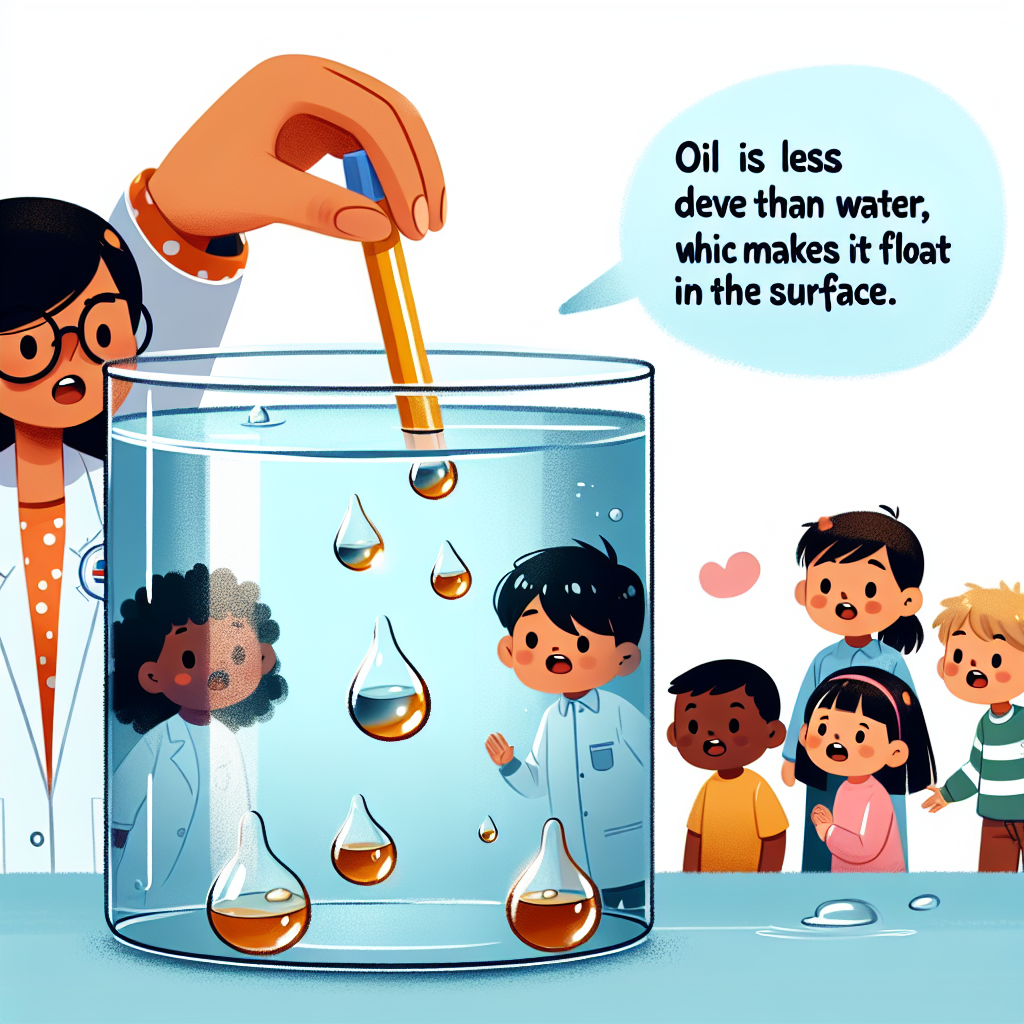
What property of oil makes it float on water?
The correct answer and explanation is :
The property of oil that makes it float on water is its lower density compared to water. Density is defined as the mass of an object per unit volume. Since oil is less dense than water, it naturally floats on the surface.
Explanation:
Density is the key property here. When substances interact, the one with a lower density will float above the one with a higher density. Water has a density of approximately 1 gram per cubic centimeter (g/cm³) at room temperature, while most oils (such as vegetable oil, olive oil, or motor oil) have densities around 0.91–0.93 g/cm³. Because oil is less dense, it floats on water.
The reason for this difference in density lies in the molecular structure of water and oil. Water molecules are highly polar, meaning they have a positive charge on one end and a negative charge on the other, which allows them to form hydrogen bonds with each other. This results in a relatively tight molecular arrangement that increases water’s density. In contrast, oil molecules are non-polar. The lack of hydrogen bonding between oil molecules allows them to spread out more loosely compared to water, making them less dense.
Additionally, the intermolecular forces in water are stronger due to hydrogen bonding, creating a denser structure. In oil, weaker Van der Waals forces are at play, which is another factor contributing to its lower density.
This phenomenon of oil floating on water is not limited to oil and water but applies to many liquids with differing densities. This is why oil and water don’t mix well, with the oil floating on top unless emulsifiers or other agents are added to alter their properties.