What type of rocks are formed by great heat and pressure?
a. Metamorphic
b. Igneous
c. Sedimentary
d. meteorites
The correct answer and explanation is :
The correct answer is a. Metamorphic.
Metamorphic rocks are formed from pre-existing rocks—known as protoliths—that undergo transformation due to significant heat, pressure, or chemically reactive fluids within the Earth’s crust. This process, called metamorphism, alters the mineral composition and structure of the original rock without melting it. Protoliths can be igneous, sedimentary, or even other metamorphic rocks.
Formation Process:
- Heat: Temperature increases with depth in the Earth’s crust, typically averaging about 30°C per kilometer. Elevated temperatures can cause minerals within the protolith to recrystallize into more stable forms. However, if the temperature is too high, the rock may melt, leading to the formation of igneous rocks instead.
- Pressure: As rocks are buried deeper, they experience greater lithostatic pressure from the weight of overlying materials. Additionally, tectonic forces at convergent plate boundaries can exert directed pressure, leading to deformation and reorientation of minerals, resulting in foliated textures characteristic of many metamorphic rocks.
- Chemically Reactive Fluids: The presence of fluids like water and carbon dioxide can facilitate the exchange of ions, promoting the growth of new mineral assemblages and accelerating metamorphic reactions.
Types of Metamorphism:
- Regional Metamorphism: Occurs over large areas under high-pressure and high-temperature conditions, typically associated with mountain-building processes where tectonic plates collide. This type often produces foliated rocks such as schist and gneiss.
- Contact Metamorphism: Happens when rocks are heated by nearby magma or lava intrusions, affecting a localized area. The intense heat alters the surrounding rock, forming non-foliated metamorphic rocks like marble and quartzite.
Examples of Metamorphic Rocks:
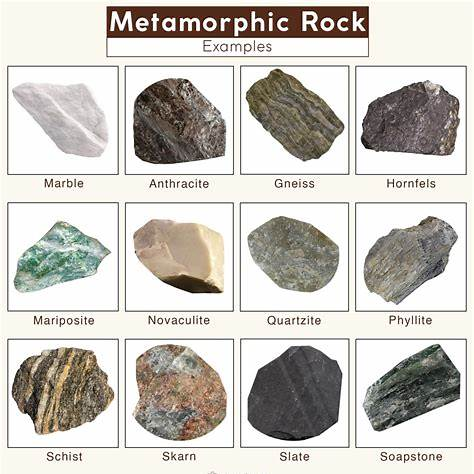
- Slate: Forms from the low-grade metamorphism of shale, characterized by fine grains and excellent cleavage properties, making it useful for roofing and flooring materials.
- Schist: Develops under medium to high-grade metamorphic conditions, displaying pronounced foliation and often containing visible mineral grains like mica.
- Gneiss: Results from high-grade metamorphism, exhibiting distinct banding due to the segregation of light and dark minerals.
- Marble: Originates from the metamorphism of limestone or dolostone, composed primarily of recrystallized calcite or dolomite, valued for sculpture and architecture.
Understanding metamorphic rocks is crucial for geologists as they provide insights into the Earth’s dynamic processes and the conditions prevalent deep within the crust.