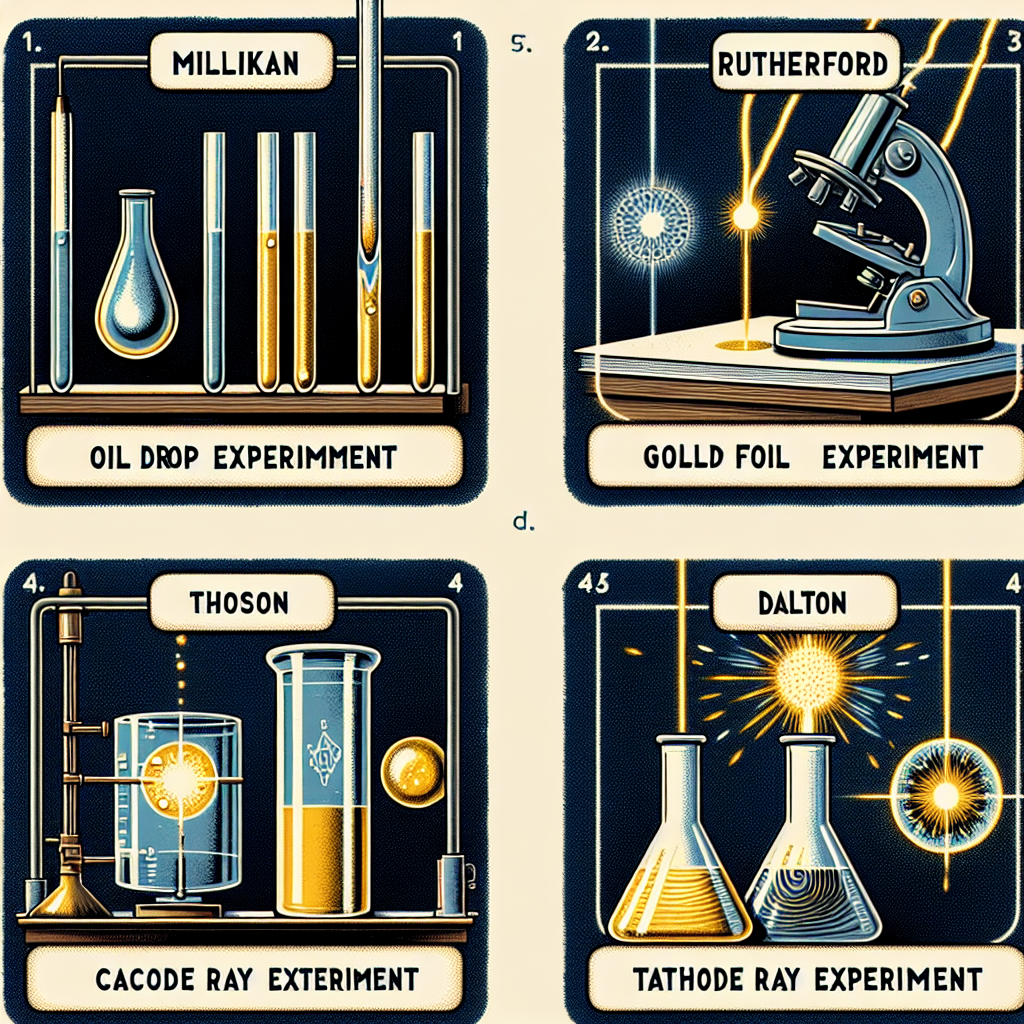
Which experiment led to the notion that the atom contains an extremely small, positively charged nucleus?
A) Millikan’s oil drop experiment
B) Rutherford’s gold foil experiment
C) Thomson’s cathode ray experiment
D) Dalton’s atomic experiment
The correct answer and explanation is :
The correct answer is B) Rutherford’s gold foil experiment.
Explanation:
Ernest Rutherford’s gold foil experiment, conducted in 1909, was the key experiment that led to the notion that the atom contains a very small, positively charged nucleus. Before this experiment, the prevailing model of the atom was J.J. Thomson’s “plum pudding” model. In this model, the atom was considered to be a uniform “pudding” of positive charge with negatively charged electrons embedded within it like “plums.”
However, Rutherford’s experiment revealed a completely different structure for the atom. In the experiment, Rutherford and his colleagues directed a beam of alpha particles (helium nuclei) at a very thin sheet of gold foil. They placed a screen coated with a fluorescent material around the foil to detect the scattered alpha particles.
The results of the experiment were surprising:
- Most of the alpha particles passed straight through the gold foil, suggesting that the atom is mostly empty space.
- Some alpha particles were deflected at small angles, which indicated that they had encountered something with a small amount of positive charge.
- A few alpha particles were deflected at large angles, and in some cases, they even bounced back toward the source.
These results could not be explained by the plum pudding model. Rutherford concluded that the atom must consist of a tiny, dense core (later named the nucleus) that is positively charged, which deflected the alpha particles. This nucleus, surrounded by largely empty space, contains almost all the mass of the atom. The electrons, in contrast, are much lighter and orbit around this dense nucleus.
This discovery was groundbreaking and fundamentally changed our understanding of atomic structure, leading to the development of the modern nuclear model of the atom. Rutherford’s work laid the foundation for future discoveries about the atom, including the later understanding of quantum mechanics and the structure of atomic nuclei.