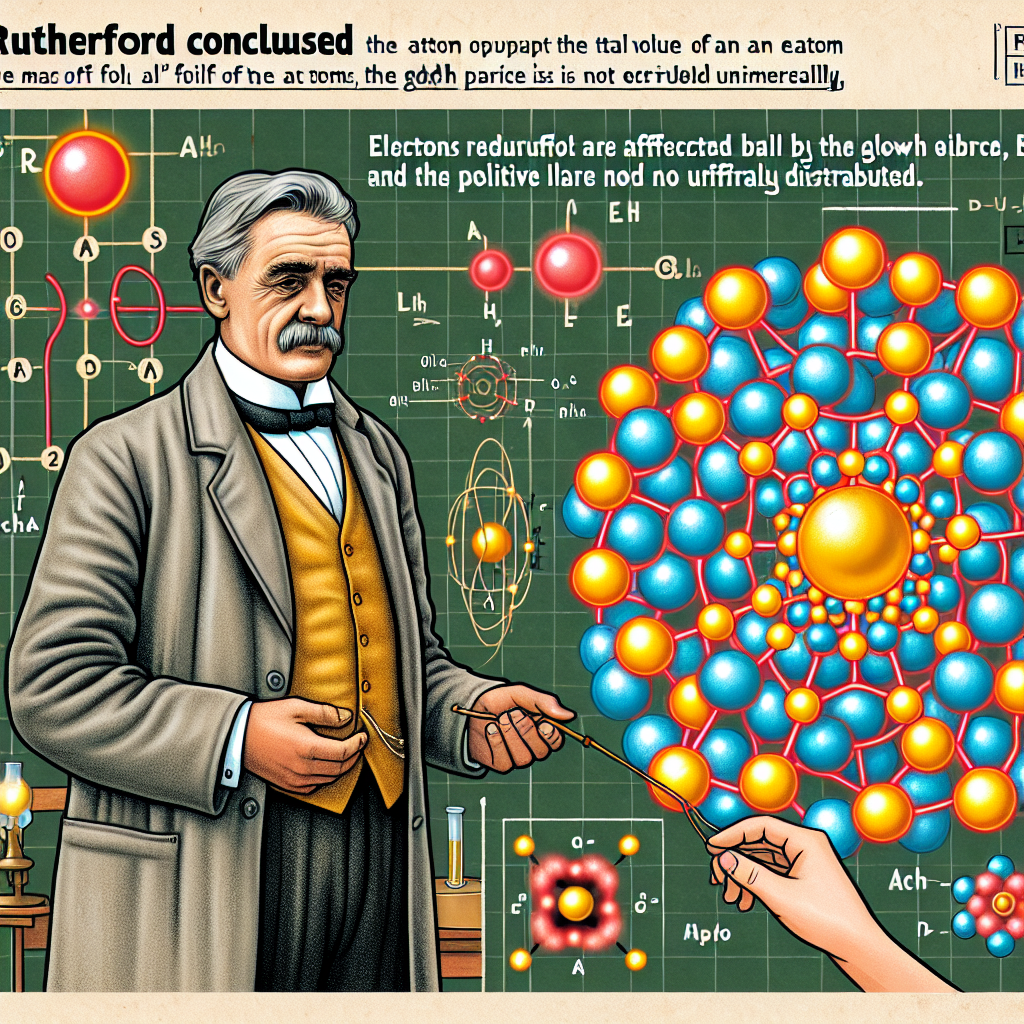
Which is a conclusion about the atom’s structure from Rutherford’s gold foil-alpha particle experiments?
A) The electrons occupy most of the total volume of an atom
B) The mass of an atom is distributed uniformly throughout the atom.
C) All alpha particles are affected the same way by the atoms in the gold foil.
D) The positive charge of the atom is uniformly distributed throughout the atom.
The correct answer and explanation is :
The correct answer is A) The electrons occupy most of the total volume of an atom.
Explanation:
Ernest Rutherford’s gold foil experiment, conducted in 1909, provided groundbreaking insights into the structure of the atom. Prior to this experiment, the prevailing model of the atom was the Thomson “plum pudding” model, which suggested that the positive charge was spread uniformly across the atom with negatively charged electrons embedded within it, like raisins in a pudding.
In Rutherford’s experiment, a beam of alpha particles (positively charged helium nuclei) was directed at a thin sheet of gold foil. Most of the alpha particles passed straight through the foil, while some were deflected at small angles, and a very small number were deflected at large angles, even bouncing straight back.
Rutherford concluded that the atom is mostly empty space, because most alpha particles passed through the foil without significant deflection. The fact that some alpha particles were deflected by large angles, however, suggested that a small, dense, positively charged center (later named the nucleus) existed within the atom, which repelled the positively charged alpha particles.
The most significant outcome of this experiment was the realization that the atom consists of a very small, dense nucleus (containing most of the atom’s mass and positive charge) surrounded by a vast region of empty space, where the electrons reside. Therefore, the electrons occupy most of the total volume of an atom. This conclusion contrasted sharply with the previous view that the positive charge was spread out.
To address the other options:
- B) The mass of an atom is distributed uniformly throughout the atom. This is incorrect because Rutherford’s experiment showed that the mass is concentrated in a tiny nucleus, not spread uniformly.
- C) All alpha particles are affected the same way by the atoms in the gold foil. This is false because the alpha particles experienced different degrees of deflection, depending on their interactions with the atom’s nucleus.
- D) The positive charge of the atom is uniformly distributed throughout the atom. This is also incorrect. Rutherford’s experiment demonstrated that the positive charge is concentrated in the tiny nucleus, not spread out.
Thus, Rutherford’s experiment led to the nuclear model of the atom, where most of the atom’s volume is occupied by the electrons, and the dense, positively charged nucleus occupies only a tiny fraction of the atom’s space.