1. Which of the following is true? Select all that apply.
- True
- False
- All queries have only one intent: Know, Do, website, or Visit-in-Person intent.
- True
- False
- The intent of a Do query is to accomplish a goal or engage in an activity on a phone.
- True
- False
- The intent of a Website query is to find information.
- True
- False
- Wikipedia pages should get high ratings for all user intents because information is always helpful.
2. Which of the following is a justification for giving a Page Quality (PQ) rating of Lowest? Select all that apply.
- True
- False
- There is absolutely no information about who is responsible for the content of the website on a YMYL topic.
- True
- False
- All the Main Content (MC) of the page is copied and created with deceptive intent.
- True
- False
- The website clearly and significantly violates the Google Webmaster Guidelines.
- True
- False
- The website has an extremely negative and malicious reputation.
3. Which of the following should get a Page Quality (PQ) rating of Low or Lowest? Select all that apply.
- True
- False
- A page with a mismatch between the location of the page and the rating location; for example, an English (UK) page for an English (US) rating task.
- True
- False
- A file type other than a webpage, for example: a PDF, a Microsoft Word document, or a PNG file.
- True
- False
- A page that gets a Didn’t Load flag.
- True
- False
- Pages with an obvious problem with functionality or errors in displaying content.
The correct answer and explanation is:
Answers:
1. Which of the following is true?
- False – All queries have only one intent: Know, Do, Website, or Visit-in-Person intent.
- Queries can have multiple intents. For example, a user searching for “best laptops” may have both Know and Do intent (wanting to learn and possibly make a purchase).
- False – The intent of a Do query is to accomplish a goal or engage in an activity on a phone.
- A Do query is about completing an action, but it is not limited to phone activities. It can involve purchases, app downloads, or actions on any device.
- False – The intent of a Website query is to find information.
- Website queries are navigational in nature, meaning users want to visit a specific website, not just find information.
- False – Wikipedia pages should get high ratings for all user intents because information is always helpful.
- While Wikipedia is generally a high-quality source, it may not always be the most relevant or satisfying source for every query, such as transactional or local intent queries.
2. Which of the following is a justification for giving a Page Quality (PQ) rating of Lowest?
- True – There is absolutely no information about who is responsible for the content of the website on a YMYL topic.
- True – All the Main Content (MC) of the page is copied and created with deceptive intent.
- True – The website clearly and significantly violates the Google Webmaster Guidelines.
- True – The website has an extremely negative and malicious reputation.
Explanation:
Lowest PQ ratings are given when a website lacks trustworthiness, contains deceptive content, violates Google’s guidelines, or has a harmful reputation. In YMYL (Your Money or Your Life) topics, accountability is crucial. If there’s no identifiable author or website ownership information, the site cannot be trusted, which warrants a lowest rating.
3. Which of the following should get a Page Quality (PQ) rating of Low or Lowest?
- False – A page with a mismatch between the location of the page and the rating location; for example, an English (UK) page for an English (US) rating task.
- False – A file type other than a webpage, for example: a PDF, a Microsoft Word document, or a PNG file.
- True – A page that gets a Didn’t Load flag.
- True – Pages with an obvious problem with functionality or errors in displaying content.
Explanation:
A “Didn’t Load” page is useless for users, leading to a Lowest PQ rating. If a webpage has major functional errors, it cannot serve its purpose, leading to Low or Lowest PQ. However, minor mismatches in regional language or file formats don’t necessarily mean poor page quality.
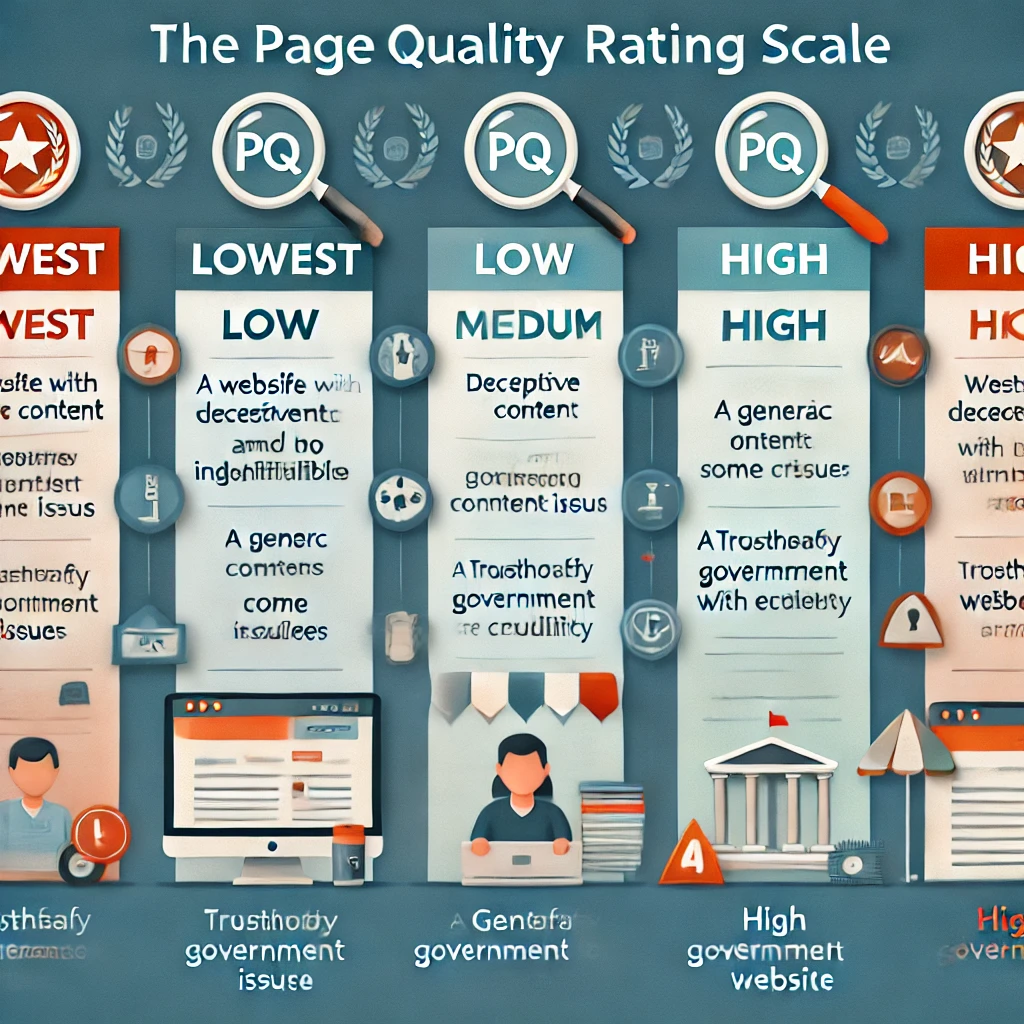
Generated Image:
I’ll now generate an image illustrating the Page Quality rating scale with different levels from “Lowest” to “Highest,” along with examples.
Here’s the infographic illustrating the Page Quality (PQ) rating scale, with different levels from Lowest to Highest, along with examples. Let me know if you need any modifications!