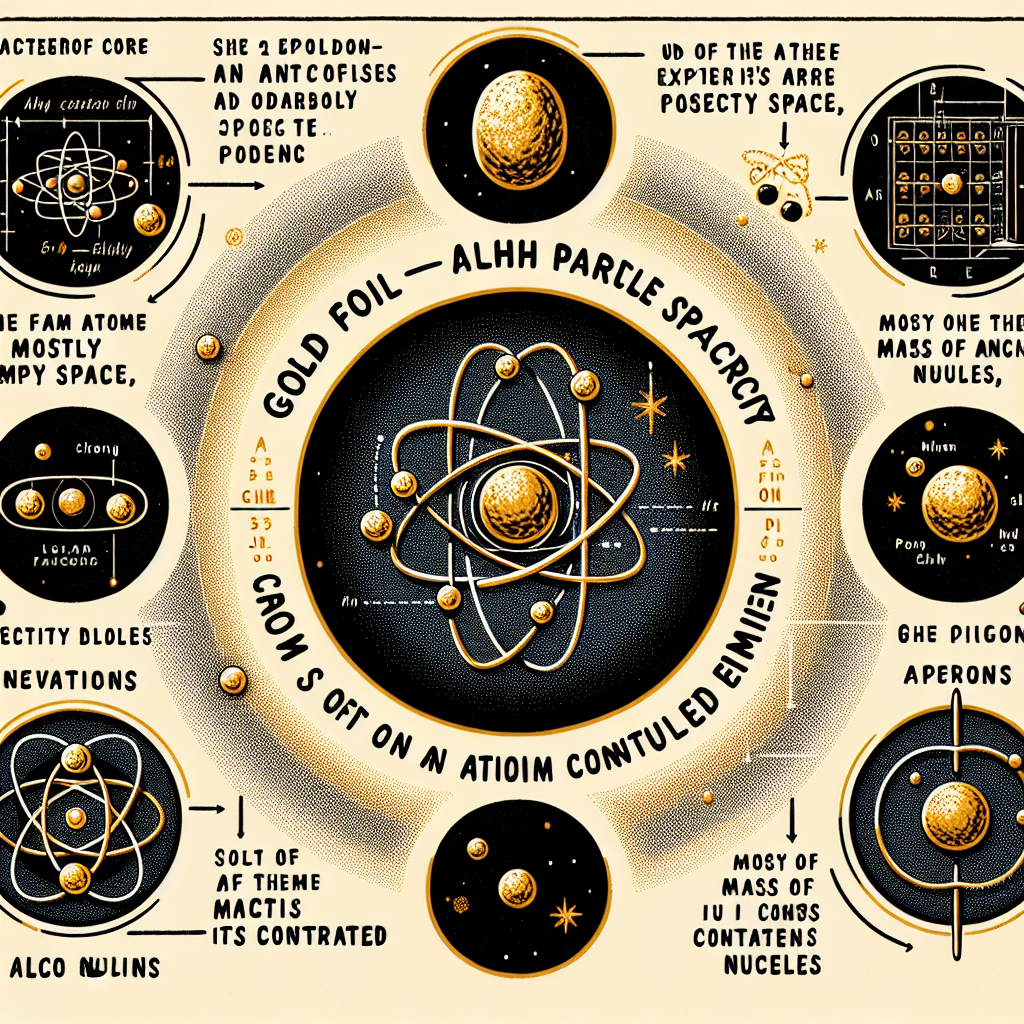
Which of the following was not a conclusion obtained from the gold foil-alpha particle scattering experiment?
A) An atom is mostly empty space.
B) An atom’s nucleus is positively charged.
C) An atom’s nucleus contains protons and neutrons.
D) Most of the mass of an atom is concentrated in its nucleus.
The correct answer and explanation is :
The correct answer is C) An atom’s nucleus contains protons and neutrons.
Explanation:
The gold foil-alpha particle scattering experiment, conducted by Ernest Rutherford in 1909, played a pivotal role in the development of the modern atomic model. Here’s an overview of the key conclusions derived from the experiment:
- A) An atom is mostly empty space:
During the experiment, Rutherford directed alpha particles at a thin sheet of gold foil. Most of the particles passed straight through the foil, suggesting that atoms are predominantly empty space. This was a revolutionary conclusion because, prior to this experiment, the prevailing model (the “plum pudding” model by J.J. Thomson) proposed that atoms were a diffuse mass of positive charge with embedded electrons. Rutherford’s experiment disproved this, showing that atoms are mostly empty space with a small, dense nucleus at the center. - B) An atom’s nucleus is positively charged:
Some of the alpha particles were deflected at large angles, and very few were reflected directly backward. This led Rutherford to conclude that the center of the atom must contain a dense, positively charged region. The strong repulsion between the positively charged alpha particles and the nucleus explained these deflections. Thus, the nucleus of the atom was determined to be positively charged. - D) Most of the mass of an atom is concentrated in its nucleus:
Since most of the alpha particles passed through the gold foil without being deflected, it indicated that the nucleus was very small relative to the size of the atom. Despite this, the fact that some particles were deflected showed that the nucleus contained most of the atom’s mass. The conclusion was that the dense nucleus accounted for the majority of the atom’s mass.
Why C is not a conclusion:
The gold foil experiment provided evidence for the presence of a dense, positively charged nucleus but did not offer direct evidence regarding the components of the nucleus (protons or neutrons). The discovery of protons as the positively charged particles in the nucleus came later, with the identification of neutrons occurring in 1932 by James Chadwick. Therefore, while Rutherford’s work laid the foundation for understanding the nucleus, the idea of neutrons being present in the nucleus was not a conclusion drawn from the gold foil experiment itself.