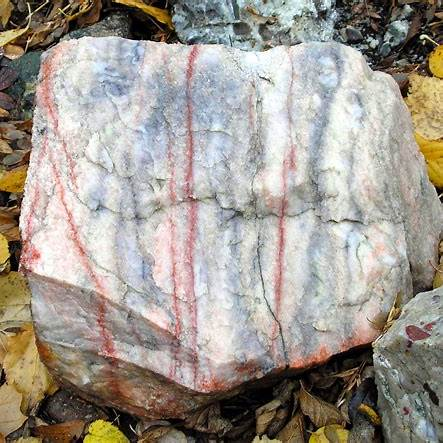
Which term best describes rocks, such as granite or marble?
a. element
b. allotrope
c. heterogeneous mixture
d. homogeneous mixture
The correct answer and explanation is :
Granite and marble are best described as heterogeneous mixtures.
A heterogeneous mixture is a material composed of distinct components that remain separate at the microscopic level, allowing individual substances to retain their unique properties. In the case of granite and marble, these rocks are composed of various minerals that are physically combined but not chemically bonded, resulting in a non-uniform composition.
Granite is an igneous rock formed from the slow crystallization of magma beneath the Earth’s surface. It primarily consists of minerals such as quartz, feldspar, and mica. These minerals are distributed unevenly throughout the rock, leading to a speckled appearance with varying colors and grain sizes. The visible differences in mineral composition and distribution within granite exemplify its heterogeneous nature.
Marble, on the other hand, is a metamorphic rock resulting from the recrystallization of limestone under high pressure and temperature conditions. It mainly comprises calcite (a crystalline form of calcium carbonate) but often contains impurities like clay minerals, iron oxides, or graphite. These impurities can create swirls and veins of different colors within the marble, further highlighting its heterogeneous characteristics.
To further clarify why granite and marble are considered heterogeneous mixtures, let’s briefly examine the other options:
- Element: An element is a pure substance consisting of only one type of atom, such as gold (Au) or oxygen (O₂). Since granite and marble contain multiple types of minerals, they cannot be classified as elements.
- Allotrope: An allotrope refers to different structural forms of the same element in the same physical state, like graphite and diamond, which are both forms of carbon. Granite and marble are not allotropes, as they are composed of various minerals, not different forms of a single element.
- Homogeneous mixture: A homogeneous mixture has a uniform composition throughout, meaning the individual components are not distinguishable, such as salt dissolved in water. Granite and marble do not have uniform compositions; their mineral components are visibly distinct, making them heterogeneous rather than homogeneous mixtures.
In summary, the diverse mineral compositions and non-uniform appearances of granite and marble clearly indicate that they are heterogeneous mixtures.