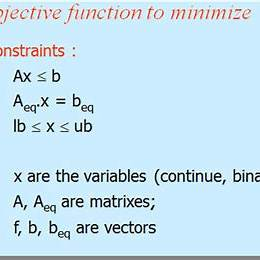
Define the Canonical form of an LPP. What is the difference between the slack variable and the surplus variable?
The correct answer and explanation is :
Canonical Form of a Linear Programming Problem (LPP)
The canonical form of an LPP is a standard way of representing a linear programming problem where:
- The objective function is in the maximization form.
- All constraints are in the form of equalities by introducing slack or surplus variables.
- All decision variables are non-negative (i.e., ( x_i \geq 0 )).
A Canonical LPP is typically written as:
[
\text{Maximize } Z = c_1x_1 + c_2x_2 + \dots + c_nx_n
]
Subject to:
[
a_{11}x_1 + a_{12}x_2 + \dots + a_{1n}x_n = b_1
]
[
a_{21}x_1 + a_{22}x_2 + \dots + a_{2n}x_n = b_2
]
[
\vdots
]
[
a_{m1}x_1 + a_{m2}x_2 + \dots + a_{mn}x_n = b_m
]
[
x_i \geq 0, \quad \forall i = 1, 2, …, n.
]
Slack Variable vs. Surplus Variable
In linear programming, slack and surplus variables are used to convert inequalities into equalities:
- Slack Variable: Introduced in ≤ (less than or equal to) constraints to convert them into equalities. It represents unused resources.
- Example: ( 2x_1 + 3x_2 \leq 8 ) → ( 2x_1 + 3x_2 + s = 8 ) (where ( s \geq 0 )).
- Surplus Variable: Introduced in ≥ (greater than or equal to) constraints to convert them into equalities. It represents excess over a requirement.
- Example: ( 4x_1 + 2x_2 \geq 10 ) → ( 4x_1 + 2x_2 – s = 10 ) (where ( s \geq 0 )).
Thus, a slack variable adds to the left-hand side of the inequality, while a surplus variable subtracts from it.