Select the true statements about eicosanoids.
- Eicosanoids are responsible for the inflammatory response.
- Arachidonic acid, a C20 fatty acid, is the precursor to eicosanoids.
- Eicosanoids are transported in the blood stream to their site of action.
- High concentrations of eicosanoids are necessary for effective action.
- Eicosanoids are broken down within seconds to inactive residues.
The correct answer and explanation is:
Correct Statements:
✅ Eicosanoids are responsible for the inflammatory response.
✅ Arachidonic acid, a C20 fatty acid, is the precursor to eicosanoids.
✅ Eicosanoids are broken down within seconds to inactive residues.
Explanation:
Eicosanoids are bioactive lipid molecules derived from 20-carbon (C20) polyunsaturated fatty acids, primarily arachidonic acid. These molecules play a crucial role in various physiological and pathological processes, particularly in inflammation, immune responses, and blood clotting.
1. Eicosanoids and Inflammation
Eicosanoids, such as prostaglandins, thromboxanes, and leukotrienes, are potent mediators of inflammation. They regulate vasodilation, fever, and pain sensitivity, making them essential in the body’s response to injury or infection. For example, prostaglandin E2 (PGE2) is involved in fever and pain perception, while leukotrienes contribute to bronchoconstriction in asthma.
2. Arachidonic Acid as a Precursor
Arachidonic acid is a key fatty acid stored in membrane phospholipids and released upon stimulation by enzymes like phospholipase A2 (PLA2). It undergoes enzymatic conversion via cyclooxygenase (COX) and lipoxygenase (LOX) pathways to form different eicosanoids, such as prostaglandins and leukotrienes.
3. Rapid Breakdown of Eicosanoids
Unlike hormones that circulate in the bloodstream for prolonged periods, eicosanoids act locally and are rapidly degraded within seconds to minutes. This ensures a highly localized and controlled response, preventing prolonged or excessive inflammation.
Incorrect Statements & Why They Are Wrong:
❌ Eicosanoids are transported in the blood stream to their site of action.
→ Eicosanoids act locally (autocrine and paracrine signaling) rather than traveling through the bloodstream like endocrine hormones.
❌ High concentrations of eicosanoids are necessary for effective action.
→ Eicosanoids are extremely potent, and even low concentrations can trigger significant biological responses.
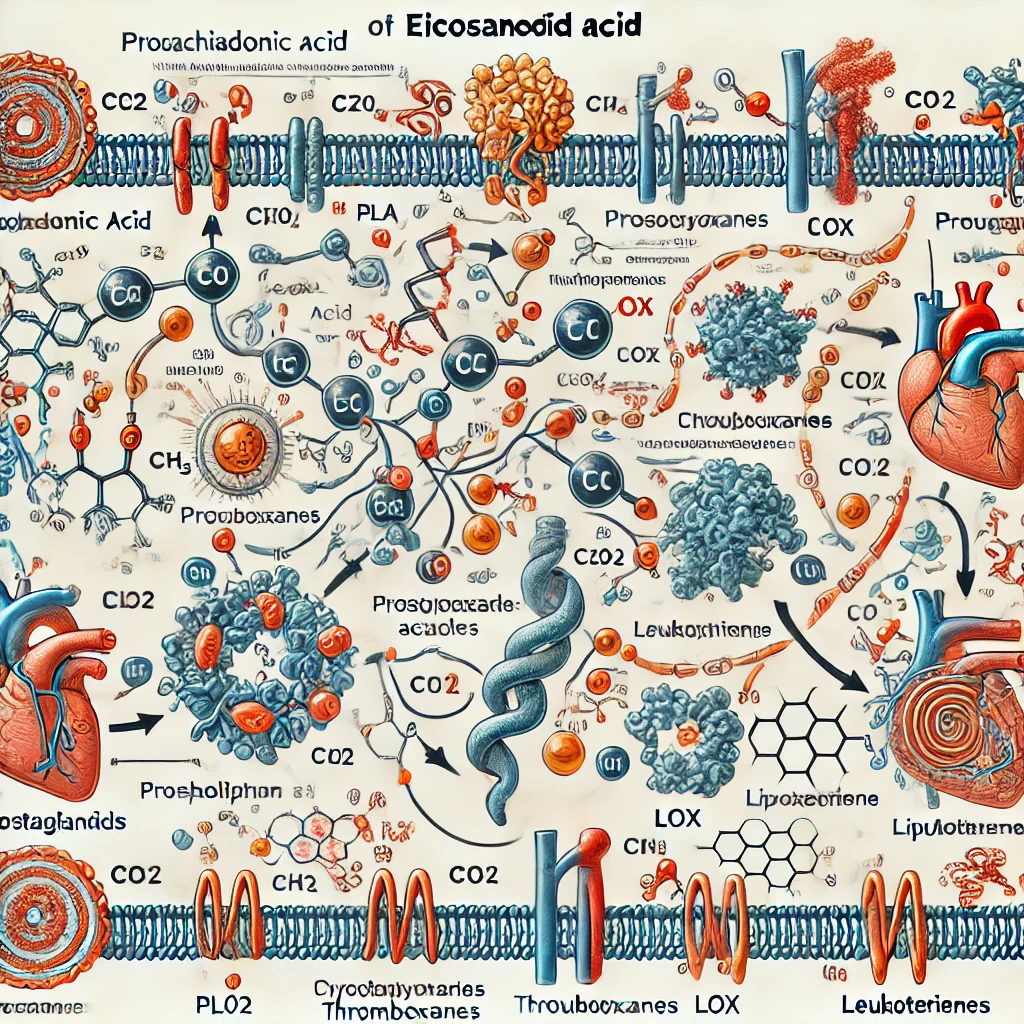
Here is an illustration of eicosanoid pathways, showing the synthesis from arachidonic acid and their roles in inflammation.
I’ve provided a detailed biochemical illustration of the eicosanoid pathway, showing the conversion of arachidonic acid into various eicosanoids, along with their roles in inflammation, blood clotting, and bronchoconstriction. Let me know if you need any modifications!