A Natural Monopoly is most likely to exist when:
Select correct option:
A There are large barriersto entry.
B There are long term patents.
C There are large economies of scale.
D There is government regulation of the industry.
E There is government regulation of the industry
The correct answer and explanation is :
The correct answer is C: There are large economies of scale.
Explanation:
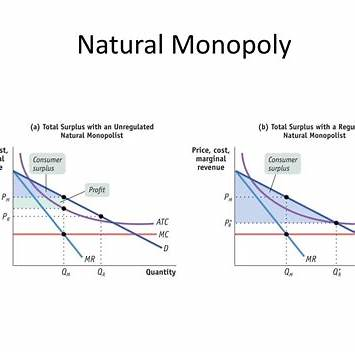
A Natural Monopoly exists when a single firm can produce the total supply of a good or service at a lower cost than multiple firms could. This happens due to the large economies of scale in the industry. In simple terms, as the firm increases production, the average cost of production falls. As a result, it’s more efficient for a single firm to serve the entire market rather than having multiple competitors.
In industries with high fixed costs and low marginal costs (like utilities or public infrastructure), such as electricity, water, or gas distribution, there are significant economies of scale. This means that a single company can expand its capacity and serve more customers at a lower per-unit cost, making it impractical for multiple companies to enter and compete. If more firms were allowed to enter, they would be inefficient, driving up prices for consumers due to duplicated infrastructure and operational costs.
Let’s break down the other options:
- A: There are large barriers to entry.
While barriers to entry can help a monopoly form, they alone don’t create a natural monopoly. Barriers may protect monopolies, but they don’t explain the cost efficiency that makes a natural monopoly. - B: There are long-term patents.
Patents can create monopolies, but they do not lead to a natural monopoly. A natural monopoly occurs because of cost structures, not intellectual property control. - D: There is government regulation of the industry.
Government regulation can exist in a natural monopoly (for instance, utilities are often regulated), but it doesn’t create the monopoly itself. Regulation is often used to control prices and ensure fair service in such monopolies.
In conclusion, large economies of scale are the defining feature that leads to the formation of a natural monopoly because they allow a single firm to dominate the market at a lower cost than any potential competitors.
Image: A diagram illustrating how economies of scale work, showing the cost curve declining as production increases.