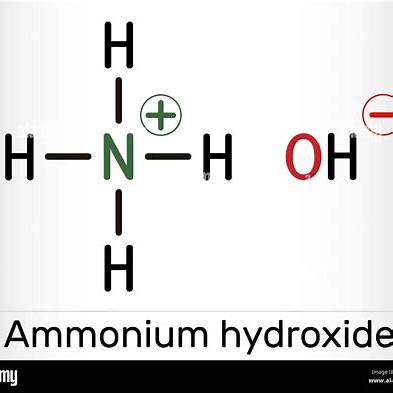
Ammonium hydroxide is a weak base because
A) it is a dilute solution.
B) it is only slightly soluble in water.
C) it cannot hold on to its hydroxide ions.
D) it dissociates only slightly in water.
E) it is completely ionized in aqueous solution.
The correct answer and explanation is :
The correct answer is D) it dissociates only slightly in water.
Explanation:
Ammonium hydroxide (( \text{NH}_4\text{OH} )) is considered a weak base because it dissociates only slightly when dissolved in water. When ammonium hydroxide dissolves in water, it partially dissociates into ammonium ions (( \text{NH}_4^+ )) and hydroxide ions (( \text{OH}^- )):
[
\text{NH}_4\text{OH} (aq) \rightleftharpoons \text{NH}_4^+ (aq) + \text{OH}^- (aq)
]
However, not all of the ammonium hydroxide molecules break apart into ions. This partial dissociation leads to a relatively low concentration of hydroxide ions in solution, which results in a weak basicity compared to strong bases like sodium hydroxide (( \text{NaOH} )), which dissociates completely in water.
Let’s break down why the other options are not correct:
- A) it is a dilute solution.
The concentration of a solution (whether dilute or concentrated) does not define whether a substance is a weak or strong base. Even in a concentrated solution, ammonium hydroxide would still be a weak base because of its limited dissociation. - B) it is only slightly soluble in water.
Ammonium hydroxide is highly soluble in water, so this statement is incorrect. - C) it cannot hold on to its hydroxide ions.
Ammonium hydroxide does indeed hold on to its hydroxide ions, but it does not release them in large quantities because it dissociates only slightly. This option is misleading. - E) it is completely ionized in aqueous solution.
A substance that is completely ionized in water is a strong base, not a weak base. Ammonium hydroxide is not completely ionized, making this statement false.
Thus, the key factor in ammonium hydroxide being a weak base is its partial dissociation in water.
Image: