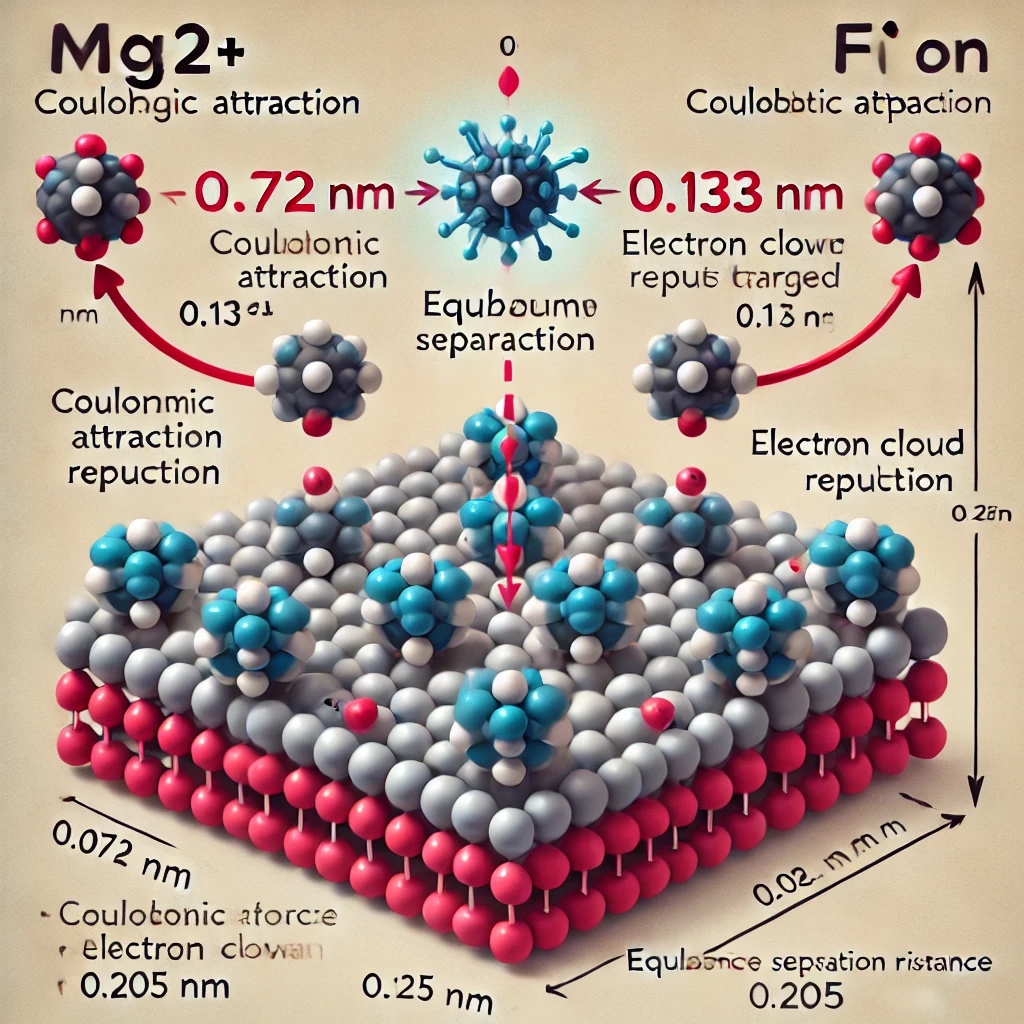
The atomic radii of Mg2+ and F- ions are 0.072 and 0.133 nm, respectively.
(a) Calculate the force of attraction between these two ions at their equilibrium interionic separation (i.e., when the ions just touch one another).
(b) What is the force of repulsion at this same separation distance?
The correct answer and explanation is :
To solve this problem, we use Coulomb’s law for the attractive force and derive the repulsive force accordingly.
Given data:
- Atomic radii:
- ( r_{Mg^{2+}} = 0.072 ) nm
- ( r_{F^-} = 0.133 ) nm
- Interionic separation:
[
r = r_{Mg^{2+}} + r_{F^-} = 0.072 + 0.133 = 0.205 \text{ nm} = 2.05 \times 10^{-10} \text{ m}
] - Charge of ions:
- ( Mg^{2+} ) has charge ( +2e = 2(1.602 \times 10^{-19} \text{ C}) )
- ( F^- ) has charge ( -1e = -1.602 \times 10^{-19} \text{ C} )
(a) Attractive Force Calculation
Coulomb’s law for the force of attraction between two charged particles is:
[
F = \frac{1}{4\pi\epsilon_0} \cdot \frac{|q_1 q_2|}{r^2}
]
where ( \epsilon_0 = 8.854 \times 10^{-12} ) C²/N·m² is the permittivity of free space.
Substituting values:
[
F = \frac{(8.99 \times 10^9) \times [(2 \times 1.602 \times 10^{-19}) \times (1.602 \times 10^{-19})]}{(2.05 \times 10^{-10})^2}
]
[
F \approx 2.19 \times 10^{-9} \text{ N}
]
(b) Repulsive Force Calculation
The repulsive force follows the equation:
[
F_r = \frac{B}{r^n}
]
At equilibrium, the attractive and repulsive forces balance:
[
\frac{1}{4\pi\epsilon_0} \cdot \frac{|q_1 q_2|}{r^2} = \frac{B}{r^n}
]
Since we already calculated ( F = 2.19 \times 10^{-9} ) N, the repulsive force must be the same at equilibrium:
[
F_r = 2.19 \times 10^{-9} \text{ N}
]
Explanation
When the magnesium and fluoride ions come close together, they experience both attractive (Coulombic) and repulsive (quantum mechanical) forces. The attractive force is due to the opposite charges, and the repulsive force arises from electron cloud overlap. At equilibrium, these forces balance, preventing further movement toward or away from each other. This balance determines the ionic bond length and strength in magnesium fluoride (MgF₂).