When an n-channel D-MOSFET has ID . IDSS, it
a. will be destroyed.
b. is operating in the depletion mode.
c. is forward-biased.
d. is operating in the enhancement mode.
The correct answer and explanation is :
The correct answer is:
d. is operating in the enhancement mode.
Explanation:
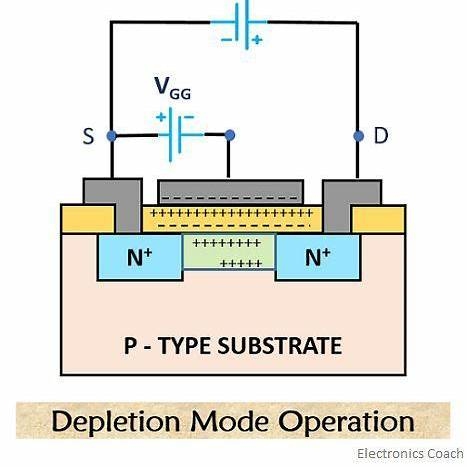
An n-channel D-MOSFET (Depletion-type Metal-Oxide-Semiconductor Field-Effect Transistor) operates in two modes: depletion mode and enhancement mode. To understand the answer, let’s break down the conditions and modes:
1. Depletion Mode (IDSS Condition):
- In depletion mode, the transistor can conduct current even when there is no gate-source voltage (V_GS = 0). The MOSFET is normally on, and the channel is pre-formed by the doping process.
- The current IDSS represents the maximum drain current in depletion mode when the gate-to-source voltage is zero (V_GS = 0). This is because the transistor, by default, has a conducting channel, and even without any gate bias, it can carry current.
- If the MOSFET’s drain current reaches IDSS, it is simply indicating that the transistor is operating at its maximum conduction level in depletion mode.
2. Enhancement Mode (ID > IDSS Condition):
- In enhancement mode, the channel is not pre-formed, and a voltage (V_GS) must be applied to enhance the conduction channel for current to flow.
- When the drain current (I_D) exceeds IDSS (i.e., ID > IDSS), the MOSFET is not in depletion mode anymore. Instead, it’s working in enhancement mode, where the gate voltage is positive enough to create a conducting channel (for an n-channel MOSFET).
Thus, when ID > IDSS, the MOSFET is in enhancement mode and behaves like a normally off device that gets turned on by the application of a positive gate-source voltage.
Additional Points:
- Option a (will be destroyed) is incorrect because reaching IDSS in a depletion-mode MOSFET does not destroy it. This value represents the maximum current for normal operation.
- Option b (is operating in depletion mode) is incorrect when ID is greater than IDSS; it indicates that the MOSFET is in enhancement mode, not depletion.
- Option c (is forward-biased) is not necessarily true in this context. The MOSFET operates based on the gate-to-source voltage rather than just being forward-biased.
Image:
Here’s an illustration showing the difference between depletion mode and enhancement mode in an n-channel MOSFET: