Which of the following is the strongest acid?
A) H3PO4
B) NH4+
C) NaOH
D) H2CO3
E) HCl
The correct answer and explanation is :
The correct answer is E) HCl (Hydrochloric acid).
Explanation:
Acidity is determined by the ability of a substance to donate protons (H⁺ ions) in solution. This strength is measured using the acid dissociation constant (Ka) or pKa values. Strong acids have high Ka values and low pKa values. Let’s analyze each option:
- H₃PO₄ (Phosphoric acid)
- A moderately strong acid but not fully dissociated in water.
- It has a pKa of 2.12 for its first dissociation, meaning it’s weaker than HCl.
- NH₄⁺ (Ammonium ion)
- A weak acid, formed from NH₃ (ammonia) reacting with H⁺.
- Has a pKa of 9.25, meaning it is much weaker than HCl.
- NaOH (Sodium hydroxide)
- Not an acid, but a strong base that dissociates completely into Na⁺ and OH⁻ in solution.
- H₂CO₃ (Carbonic acid)
- A weak acid, with a pKa of 6.35 for the first dissociation.
- It does not fully dissociate in water.
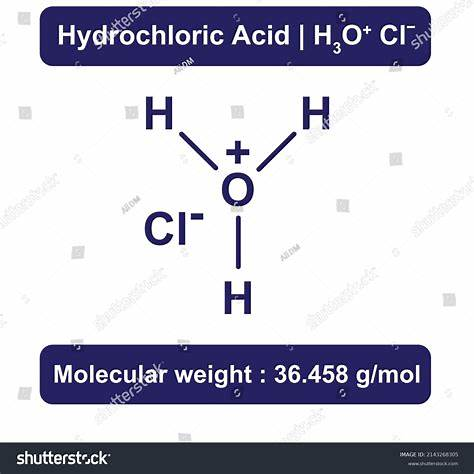
- HCl (Hydrochloric acid) – Strongest Acid
- A strong acid, meaning it completely ionizes in water: HCl→H++Cl−HCl \rightarrow H^+ + Cl^-
- Has a pKa of approximately -6.3, making it much stronger than all the other acids listed.
Conclusion:
HCl is the strongest acid among the given choices because it fully dissociates in water, releasing maximum H⁺ ions and having a very low pKa value.