Explain briefly ohmic and non-ohmic statements. Give two examples for each material type.
The correct answer and explanation is :
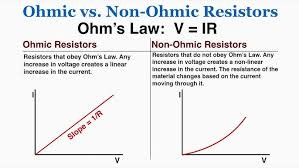
Ohmic materials are those that adhere to Ohm’s Law, which states that the current (I) passing through a conductor between two points is directly proportional to the voltage (V) across those points, provided the temperature and other physical conditions remain constant. This relationship is mathematically expressed as V = IR, where R represents the resistance. In ohmic materials, this proportionality results in a linear current-voltage (I-V) characteristic, meaning that if the voltage is doubled, the current also doubles, indicating a constant resistance. Common examples of ohmic materials include:
- Copper: Widely used in electrical wiring due to its excellent conductivity and consistent resistance across varying voltages and currents.
- Aluminum: Commonly utilized in power transmission lines; it maintains a stable resistance under different electrical conditions.
Non-ohmic materials, on the other hand, do not follow Ohm’s Law. In these materials, the relationship between voltage and current is nonlinear, meaning the resistance varies with changes in voltage or current. This nonlinearity can arise due to factors like temperature changes, material composition, or specific structural properties. Examples of non-ohmic materials include:
- Diodes: Semiconductor devices that allow current to flow primarily in one direction. Their I-V characteristic is nonlinear, with current increasing exponentially with applied forward voltage after a certain threshold.
- Thermistors: Temperature-sensitive resistors whose resistance changes significantly with temperature variations. They are categorized into Negative Temperature Coefficient (NTC) thermistors, where resistance decreases with increasing temperature, and Positive Temperature Coefficient (PTC) thermistors, where resistance increases with rising temperature.
Detailed Explanation (300 words):
Understanding the distinction between ohmic and non-ohmic materials is fundamental in electrical and electronic engineering, as it influences how components behave in circuits.
Ohmic Materials:
Ohmic materials exhibit a linear I-V relationship, meaning their resistance remains constant regardless of the applied voltage or current. This predictable behavior simplifies circuit analysis and design. Metals like copper and aluminum are quintessential ohmic materials due to their free electron availability, which facilitates consistent conductivity. For instance, in a copper wire, doubling the applied voltage results in a proportional doubling of current, maintaining a constant resistance. This characteristic is crucial for components like resistors, which are designed to provide specific resistance values to control current flow within circuits.
Non-Ohmic Materials:
Non-ohmic materials have a nonlinear I-V relationship, meaning their resistance changes with variations in voltage or current. This nonlinearity can be due to several factors:
- Diodes: Constructed from semiconductor materials, diodes permit current flow predominantly in one direction. Their I-V curve shows minimal current flow until the forward voltage reaches a certain threshold (known as the “cut-in” voltage), after which current increases rapidly. This property is exploited in rectification processes, where alternating current (AC) is converted to direct current (DC).
- Thermistors: These are resistors with resistance that varies significantly with temperature. NTC thermistors decrease in resistance as temperature rises, making them suitable for temperature sensing and inrush current limiting. PTC thermistors, conversely, increase in resistance with rising temperature, which is useful in overcurrent protection as they can limit excessive current by increasing resistance when temperatures become too high.
The nonlinear behavior of non-ohmic materials is harnessed in various applications:
- Voltage Regulation: Zener diodes, a type of diode, are used to maintain a stable output voltage despite variations in input voltage or load conditions, owing to their precise breakdown voltage characteristics.
- Temperature Sensing: Thermistors are widely used in devices requiring accurate temperature measurements, such as digital thermometers and temperature-compensated circuits.
In summary, the classification into ohmic and non-ohmic materials is pivotal for designing and analyzing electrical circuits, ensuring components function as intended under varying electrical conditions.