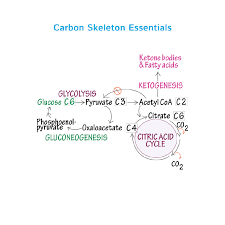
Substances to which amino acid carbon “skeletons” may be degraded include
a.acetyl CoA
b.citrate
c.succinate
d.more than one correct response
e.no correct response
The correct answer and explanation is :
The correct answer is:
d. More than one correct response (a. Acetyl CoA and c. Succinate).
Explanation:
When amino acids are broken down, their carbon skeletons (the part remaining after the removal of the amino group) can enter various metabolic pathways. This degradation process allows amino acids to contribute to energy production, gluconeogenesis (glucose synthesis), and biosynthesis of other molecules.
There are two main categories of amino acids based on their metabolic fate:
- Glucogenic Amino Acids: These amino acids are degraded into intermediates of the citric acid (Krebs) cycle or pyruvate, which can be used to generate glucose.
- Ketogenic Amino Acids: These are broken down into acetyl-CoA or acetoacetate, which are precursors for ketone bodies and fatty acid synthesis.
Degradation Pathways of Amino Acids
- Acetyl-CoA (Option A)
Some amino acids (e.g., leucine, lysine, isoleucine, phenylalanine, and tryptophan) are broken down into acetyl-CoA. Acetyl-CoA can enter the citric acid cycle or be used for ketone body production. - Citrate (Option B) – Incorrect
While acetyl-CoA contributes to the formation of citrate in the citric acid cycle, amino acid carbon skeletons are not directly degraded into citrate. - Succinate (Option C)
Some glucogenic amino acids (e.g., methionine, isoleucine, and valine) can be converted into succinyl-CoA, which further converts into succinate in the citric acid cycle.
Since amino acids can be degraded into both acetyl-CoA and succinate, the correct answer is (d) More than one correct response.