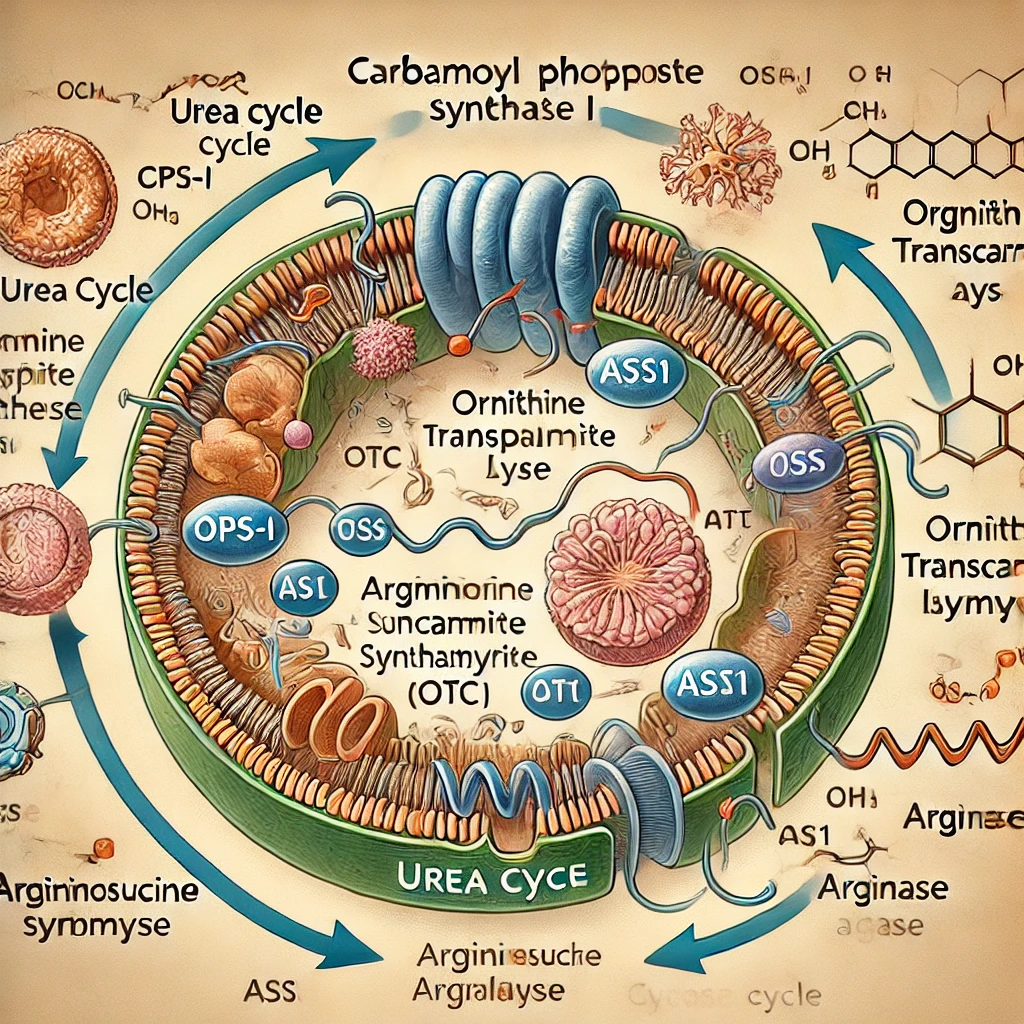
All of the reactions of the urea cycle occur within mitochondria.
a.All three statements are true.
b.Two of the three statements are true.
c.Only one of the statements is true.
d.None of the statements is true.
The correct answer and explanation is :
Correct Answer: c. Only one of the statements is true.
Explanation:
The urea cycle, also known as the ornithine cycle or Krebs-Henseleit cycle, is the metabolic pathway that eliminates excess nitrogen by converting ammonia into urea, which is excreted in urine. It consists of five enzymatic reactions, some of which occur in the mitochondria and others in the cytoplasm.
- Mitochondrial Reactions:
- Carbamoyl phosphate synthetase I (CPS-I): This enzyme catalyzes the first step of the urea cycle by converting ammonia and bicarbonate into carbamoyl phosphate. This step occurs inside the mitochondria of liver cells.
- Ornithine transcarbamylase (OTC): This enzyme catalyzes the transfer of the carbamoyl group from carbamoyl phosphate to ornithine, forming citrulline. This reaction also occurs inside the mitochondria.
- Cytoplasmic Reactions:
- Argininosuccinate synthetase (ASS): Citrulline is transported to the cytoplasm, where it reacts with aspartate to form argininosuccinate.
- Argininosuccinate lyase (ASL): This enzyme splits argininosuccinate into arginine and fumarate.
- Arginase (ARG1): Arginase hydrolyzes arginine to produce urea and ornithine. The urea is excreted, while ornithine is transported back into the mitochondria for another cycle.
Since only the first two reactions of the urea cycle occur within the mitochondria, while the remaining three take place in the cytoplasm, the statement that all reactions of the urea cycle occur within mitochondria is false.
Thus, only one of the three statements is correct, making option (c) the right answer.