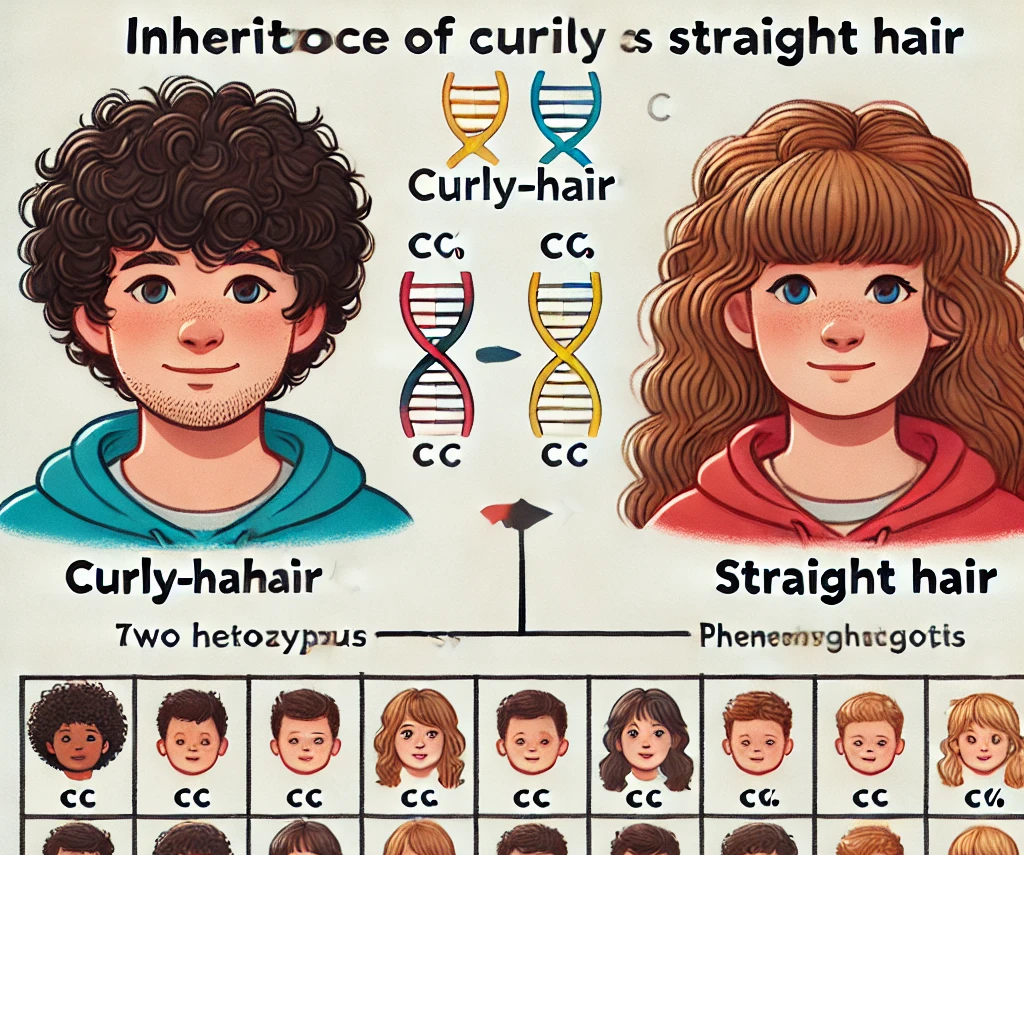
Curly hair (C) is dominant over straight hair (c). If two heterozygous curly haired people had children. Show Punnett square on separate paper.
a. What would be the phenotype ratio?
A) 100% curly
B) 50:50
C) 3:1 or 75% curly
D) 1:3 or 25% curly
The correct answer and explanation is :
Correct Answer: C) 3:1 or 75% curly
Explanation:
The inheritance of curly hair follows Mendelian genetics, where curly hair (C) is dominant over straight hair (c). When two heterozygous (Cc) individuals reproduce, we can use a Punnett square to determine the probability of different genotypes and phenotypes among their offspring.
Step 1: Setting Up the Punnett Square
Each parent has the genotype Cc (heterozygous for curly hair). The possible alleles they can pass on are:
| C | c | |
|---|---|---|
| C | CC | Cc |
| c | Cc | cc |
The Punnett square gives us the following genotype probabilities:
- CC (homozygous dominant) → 1/4 (25%)
- Cc (heterozygous) → 2/4 (50%)
- cc (homozygous recessive) → 1/4 (25%)
Step 2: Determining the Phenotype Ratio
- CC and Cc both result in curly hair (since C is dominant).
- cc results in straight hair (since there is no dominant allele present).
Thus, the phenotype ratio is:
- Curly-haired offspring (CC or Cc) = 3 out of 4 (75%)
- Straight-haired offspring (cc) = 1 out of 4 (25%)
This gives a phenotype ratio of 3:1, which matches answer choice C (3:1 or 75% curly).
Conclusion
This classic Mendelian inheritance pattern is an example of dominant and recessive traits in genetics. Even though both parents have curly hair, there is a 25% chance of a child inheriting straight hair if they receive two recessive (c) alleles. Conversely, there is a 75% chance that the child will inherit curly hair, with some being heterozygous (Cc) and others homozygous dominant (CC).