Explain why 2, 2-dimethylpropane (C_5H_12) has a lower boiling point (9.5 degree C) than pentane which boils at 36.1 degree C. Draw each molecule and analyze intermolecular forces (IMFs) as part of your discussion.
The correct answer and explanation is :
Answer:
2,2-Dimethylpropane and pentane both have the molecular formula ( C_5H_{12} ), meaning they are structural isomers. However, they have different boiling points due to differences in their intermolecular forces.
Pentane is a straight-chain alkane, which allows for more surface area contact between molecules. This increases the strength of London dispersion forces (LDFs), which are the primary intermolecular forces present in nonpolar hydrocarbons. Stronger LDFs lead to a higher boiling point, as more energy is required to separate the molecules.
In contrast, 2,2-dimethylpropane is a highly branched molecule. Its compact, nearly spherical shape reduces the surface area available for intermolecular interactions. As a result, the London dispersion forces are weaker compared to pentane, leading to a lower boiling point. The reduced strength of these forces means that less energy is needed to transition from the liquid to the gas phase, explaining its boiling point of only 9.5°C.
Summary of Factors Affecting Boiling Points:
- Molecular shape: Straight-chain molecules (pentane) have more surface area for interactions, increasing IMF strength.
- London dispersion forces: More significant in pentane due to greater molecular contact.
- Compactness: 2,2-Dimethylpropane is more compact, reducing IMF strength and lowering its boiling point.
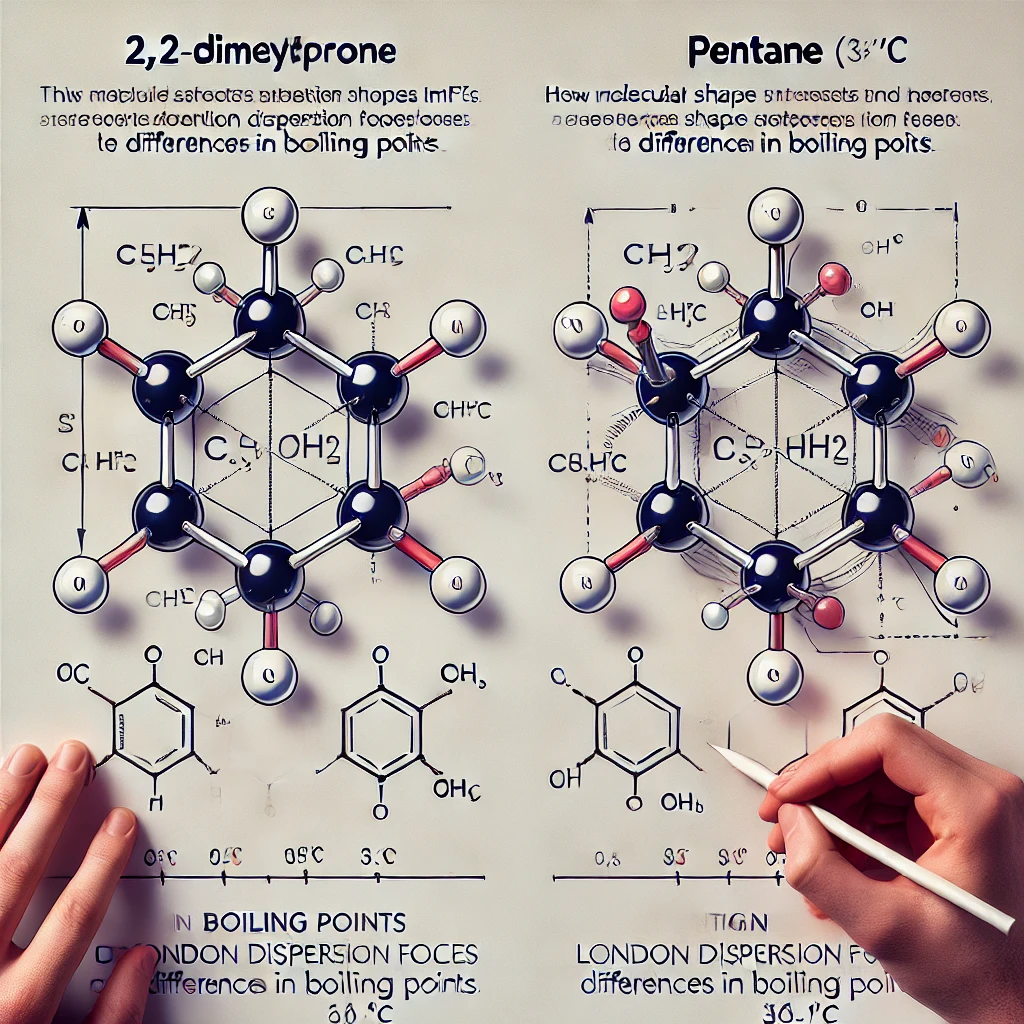
Here is an image created with DALL·E, comparing the structures of 2,2-dimethylpropane and pentane. It highlights their boiling points and explains how molecular shape affects London dispersion forces.