How many degrees are in a full circle? Another way to measure angles is using radians. A radian is… How many radii wrap around half of the circle? How many radians would be in a central angle measuring 180°? How many radii wrap around a full circle? How many radians would be in one full circle? What is the degree measure of the central angle formed by an arc length of one radius?
The correct answer and explanation is :
Correct Answers:
- A full circle has 360°.
- A radian is the angle subtended by an arc equal in length to the circle’s radius.
- π (or approximately 3.14) radii wrap around half of the circle.
- A central angle of 180° is equal to π radians.
- 2π (or approximately 6.28) radii wrap around a full circle.
- A full circle contains 2π radians.
- The degree measure of a central angle formed by an arc length of one radius is 57.3° (which is 1 radian).
Explanation:
In geometry, a circle is divided into 360 degrees (°), a convention dating back to the Babylonians, who used a base-60 number system. However, angles can also be measured using radians, a more natural unit in advanced mathematics, physics, and engineering.
A radian is the angle created when the arc length is equal to the radius of the circle. If you take the circumference of a circle, which is 2πr, and divide by the arc length r, you get 2π radians in a full circle. This means:
- Half a circle (180°) = π radians
- A full circle (360°) = 2π radians
To determine how many radii fit along half the circumference, divide πr (half the circumference) by r, resulting in π radii. Likewise, for the full circle, dividing 2πr by r gives 2π radii.
A special case is when the arc length equals the radius. Since r/r = 1, the corresponding angle is 1 radian, which is about 57.3°. This relationship helps in understanding how radians function as a natural angular measurement system.
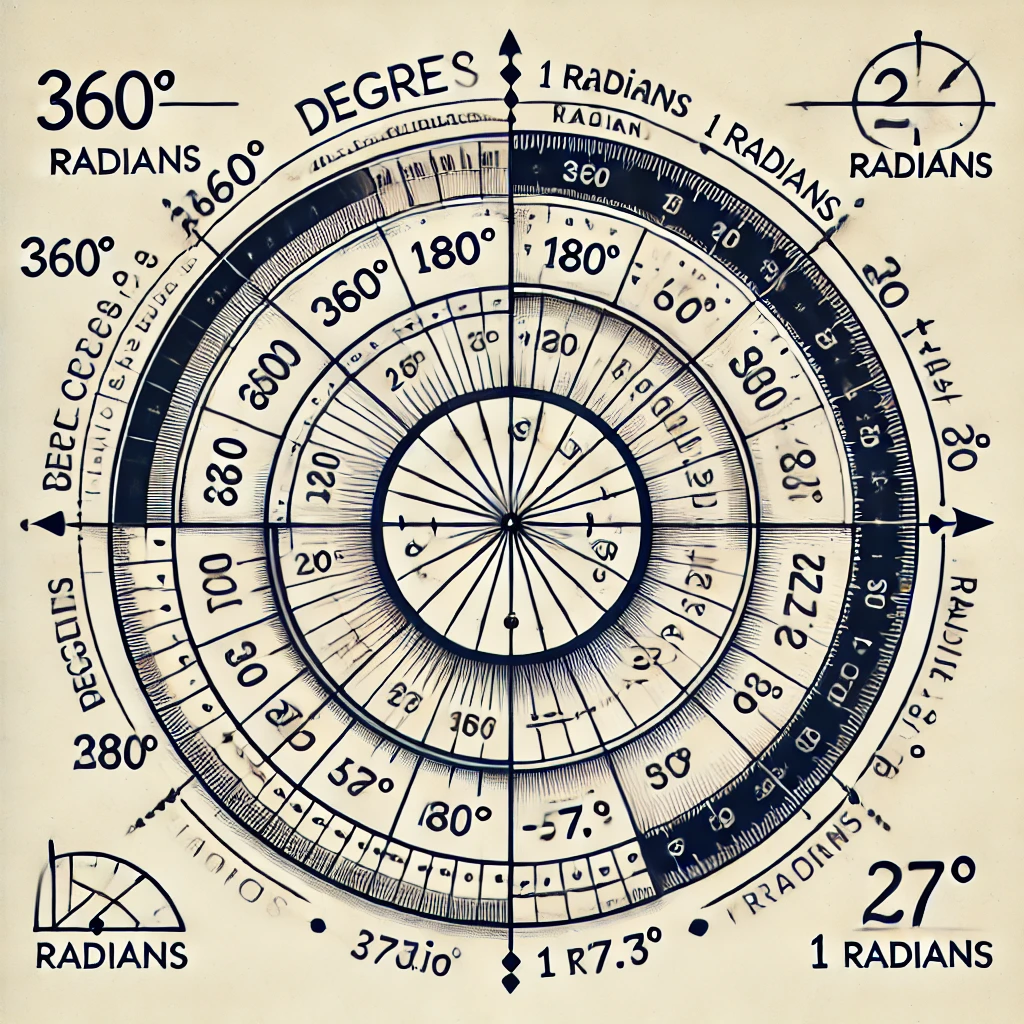
Here is an image generated with DALL·E to visually represent the relationship between degrees and radians in a circle. It includes key labels such as 360° = 2π radians, 180° = π radians, and the concept of 1 radian being approximately 57.3°.