What are rocks below and above a fault called?
the lower wall below and the hanging wall above
the lower wall below and the upper wall above
the footwall below and the upper wall above
the hanging wall below and the footwall above
the footwall below and the hanging wall above
The correct answer and explanation is:
Correct Answer:
The footwall is below, and the hanging wall is above.
Explanation:
A fault is a fracture in the Earth’s crust where rocks on either side have moved relative to each other. The terms footwall and hanging wall are used to describe the blocks of rock on either side of an inclined fault plane.
- Footwall (Below the Fault Plane)
- The footwall is the block of rock that lies beneath the fault plane.
- It gets its name because if you were standing on the fault, this is the side where your feet would be.
- In a normal fault, the footwall moves upward relative to the hanging wall, while in a reverse fault, it moves downward.
- Hanging Wall (Above the Fault Plane)
- The hanging wall is the block of rock that sits above the fault plane.
- The term originates from mining, where miners would visualize this block as a “ceiling” hanging over them.
- In a normal fault, the hanging wall moves downward relative to the footwall. In a reverse fault, it moves upward.
Fault Types:
- Normal Fault: The hanging wall moves downward relative to the footwall due to tensional forces.
- Reverse Fault: The hanging wall moves upward due to compressional forces.
- Strike-Slip Fault: Movement is primarily horizontal, and the footwall/hanging wall distinction is less relevant.
Understanding these terms is crucial in geology, helping scientists determine how tectonic forces shape the Earth’s surface over time.
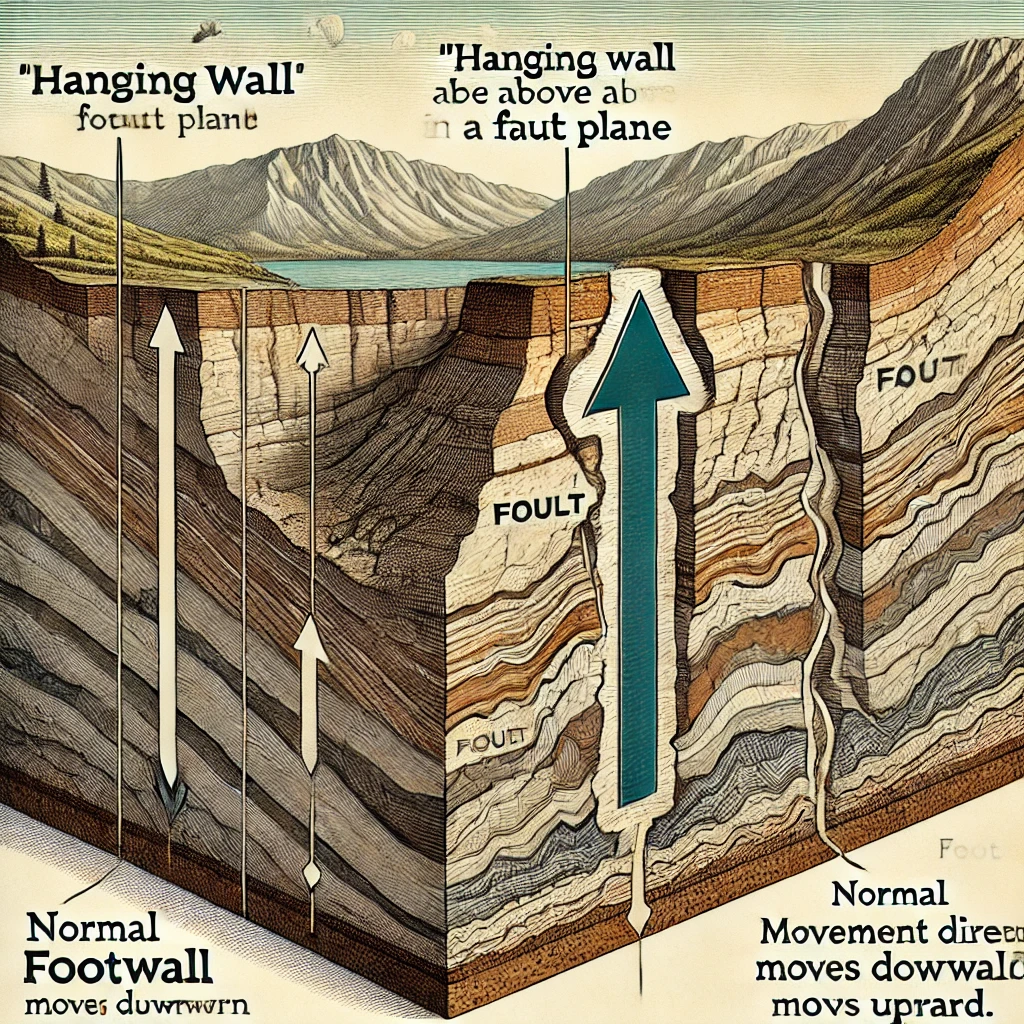
Now, generating an image to illustrate the footwall and hanging wall concept.
Here is the image illustrating the footwall and hanging wall in a fault. It was created using DALL·E, OpenAI’s image generation model. Let me know if you need any modifications or further explanations!