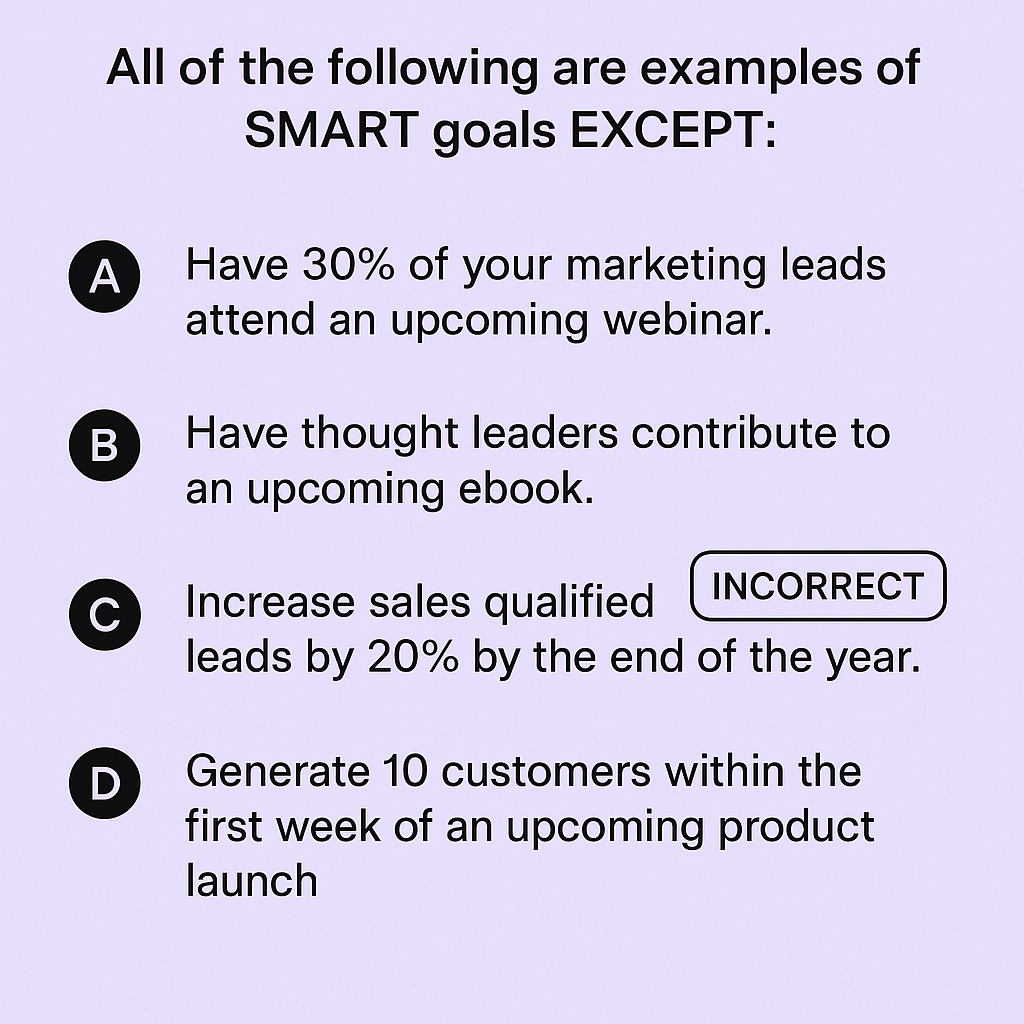
All of the following are examples of SMART goals EXCEPT:
Have 30% of your marketing leads attend an upcoming webinar.
Have thought leaders contribute to an upcoming ebook.
Increase sales qualified leads by 20% by the end of the year.
Generate 10 customers within the first week of an upcoming product launch.
The correct answer and explanation is :
The correct answer is: Have thought leaders contribute to an upcoming ebook.
Explanation (300 words):
SMART goals are Specific, Measurable, Achievable, Relevant, and Time-bound. These criteria help ensure that goals are well-defined and trackable, making them more effective for planning and execution.
Let’s evaluate each option to determine which does not meet the SMART criteria:
- “Have 30% of your marketing leads attend an upcoming webinar.”
- Specific: It clearly defines who (marketing leads) and what (attend a webinar).
- Measurable: The 30% figure provides a quantifiable target.
- Achievable: Assuming proper outreach, this is potentially doable.
- Relevant: Tied to marketing goals.
- Time-bound: Linked to the “upcoming” webinar, suggesting a clear deadline.
- “Increase sales qualified leads by 20% by the end of the year.”
- Specific: Focuses on increasing sales-qualified leads.
- Measurable: 20% increase is a clear metric.
- Achievable: Can be assessed based on current resources and pipeline.
- Relevant: Directly supports sales and marketing efforts.
- Time-bound: Deadline is “by the end of the year.”
- “Generate 10 customers within the first week of an upcoming product launch.”
- Specific: Refers to customer acquisition.
- Measurable: Goal is 10 customers.
- Achievable: Depends on market size, but the number is concrete.
- Relevant: Supports product launch success.
- Time-bound: “Within the first week” gives a clear timeframe.
- “Have thought leaders contribute to an upcoming ebook.”
- While this goal is relevant, it lacks other SMART elements:
- Not Measurable: How many thought leaders?
- Not Time-bound: When should this happen?
- Not Specific enough: “Contribute” is vague—writing a chapter? Giving quotes?
Thus, it does not meet the SMART criteria fully, making it the exception.